
Introduction
Social work in England is currently experiencing a period of significant change. Alongside continuing workforce pressures, increasing complexity in family situations and growing expectations regarding evidence-informed practice, the profession is preparing for the introduction of the Department for Education’s Early Career Standards for child and family social workers. The standards place renewed emphasis on relationship-based practice, professional judgement, reflection, critical thinking and ongoing professional development.
As both a social worker and practice educator working in England, I find this shift encouraging. For many years, conversations regarding workforce sustainability have focused on resilience, wellbeing and retention. These remain important concerns. However, contemporary practice also raises another question:
How do social workers maintain the capacity to think effectively within increasingly complex environments?
This question feels particularly relevant as expectations on practitioners continue to expand. Social workers are required to balance relationship-based practice with safeguarding responsibilities, evidence-informed interventions, multi-agency working, legal processes and increasing accountability. They are expected to assess risk, tolerate uncertainty, analyse competing narratives and make decisions that can significantly impact the lives of children and families.
Social work is therefore not only an emotionally demanding profession. It is fundamentally a thinking profession (Trevithick, 2012).
The English Context: A Profession Asked to Think
Recent developments within English social work suggest a growing recognition of the importance of reflective and analytical practice. The Early Career Standards, which will replace the previous Knowledge and Skills Statements, provide a more detailed description of what newly qualified social workers should know and be able to do during the first two years of practice. They emphasise relationship-based, anti-discriminatory and evidence-informed practice and are designed to support professional development, supervision and assessment.
Perhaps most significantly, the standards repeatedly highlight reflection, curiosity, critical thinking and professional judgement. Standard 6, "Reflects on and Develops Professional Practice", identifies structured reflection as an essential component of effective practice. The standards highlight the importance of challenging assumptions, widening thinking, generating alternative explanations, recognising cognitive bias and using supervision to support analysis and decision-making.
These developments reflect a broader reality within English social work. Children and families often present with interconnected experiences of poverty, trauma, discrimination, domestic abuse, mental ill-health, substance misuse and exploitation. Practitioners are required to make sense of these complexities whilst operating within systems that can be shaped by high workloads, workforce instability and competing organisational demands.
The challenge therefore may not simply be whether practitioners possess sufficient knowledge or resilience. It may also be whether they have sufficient opportunity, support and structure to think effectively.
Why Thinking Matters
Professional judgement sits at the heart of social work practice. Good judgement requires more than procedural compliance or knowledge acquisition. It requires practitioners to analyse information, tolerate uncertainty, identify patterns, test hypotheses and integrate professional knowledge with lived experience.
Professional standards consistently reinforce reflection as central to safe and effective social work practice (Social Work England, 2025a). Research on reflective practice similarly highlights the importance of reflexivity, critical reflection and professional reasoning in helping practitioners navigate complex situations (Fook and Gardner, 2007; Thompson and Pascal, 2012).
Reflective supervision literature further suggests that supportive, reflective spaces contribute not only to practitioner wellbeing but also to professional learning, decision-making and effective intervention (Ravalier et al., 2023). Yet valuing reflection and creating conditions for reflection are not necessarily the same thing. A profession can recognise the importance of reflective thinking whilst simultaneously operating within environments that make reflective thinking increasingly difficult.
Thinking Capacity as an Emerging Concept
Within this context, I propose the concept of thinking capacity as one possible way of understanding professional functioning within contemporary social work.
Thinking capacity can be defined as:
The ability to maintain reflective, analytical and relational functioning under conditions of complexity, uncertainty and pressure.
Thinking capacity is not synonymous with intelligence. Nor is it identical to resilience.
A practitioner may demonstrate considerable resilience whilst simultaneously struggling to maintain reflective and analytical functioning because cognitive and emotional demands have become overwhelming. Similarly, a practitioner may possess significant knowledge but find it difficult to apply effectively when opportunities for reflection become limited.
Thinking capacity therefore draws together a number of interconnected processes:
- Reflection
- Analysis
- Sense-making
- Professional curiosity
- Relational awareness
- Critical reasoning
- Purposeful intervention
This conceptualisation builds upon existing literature relating to reflection, reflexivity and professional judgement whilst proposing thinking capacity as a distinct but related concept (Fook and Gardner, 2007; Thompson and Pascal, 2012).
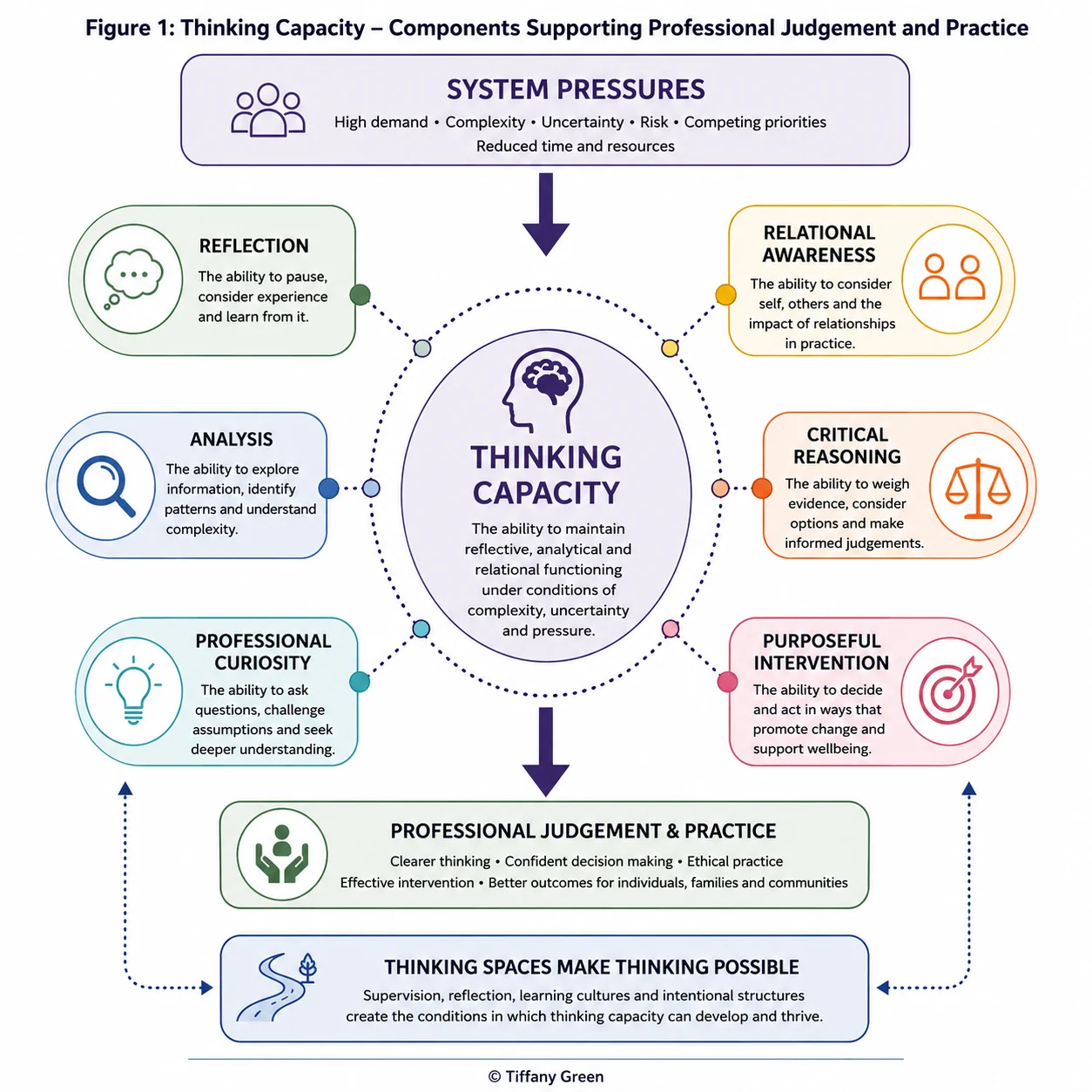
Read the diagram description
The diagram places system pressures above a thinking-capacity framework. Its connected elements are reflection, analysis, sense-making, professional curiosity, relational awareness, critical reasoning and purposeful intervention. See the surrounding article for the author’s explanation.
Implications for Social Work Education
The growing emphasis on reflective and evidence-informed practice within England's Early Career Standards raises important questions for social work education. The standards highlight the importance of structured reflection, curiosity, supervision, critical evaluation of evidence and recognition of cognitive bias. These expectations are not additional tasks for practitioners; they are increasingly central to safe and effective practice.
In my work as a social worker and practice educator, I have observed that students often struggle less with acquiring knowledge than with making sense of complexity in real time. Many can describe theories, legislation and models of practice. The greater challenge frequently lies in applying that knowledge when faced with competing information, uncertainty, emotional pressure and the realities of organisational practice. This is not a criticism of students. Rather, it reflects the complexity of contemporary social work itself.
Students frequently enter practice environments whilst simultaneously developing professional identity, learning organisational cultures, applying theory and managing uncertainty. They are required to balance relationship-based practice with safeguarding responsibilities, risk assessment, evidence-informed interventions and multi-agency working. The question therefore becomes:
Are we teaching social workers what to think, or are we also teaching them how to think?
The Early Career Standards provide a useful starting point. They emphasise structured reflection, curiosity, supervision, critical evaluation of evidence and recognition of cognitive bias. These expectations suggest a need for educational approaches that intentionally develop thinking processes alongside knowledge and skills. This may involve:
- Structured reflection opportunities
- Explicit teaching of analytical reasoning
- Protected thinking spaces within practice learning
- Reflective supervision
- Assessment approaches that explore reasoning as well as outcomes
Creating Thinking Spaces
One practical response may involve intentionally creating what I describe as thinking spaces. Thinking spaces are intentional environments, structures or processes designed to support reflection, analysis and professional reasoning. Examples might include:
- Reflective supervision
- Group reflection forums
- Structured analytical tools
- Peer consultation
- Reflective discussions within practice learning
Importantly, thinking spaces are not simply opportunities to discuss feelings or workloads. They are conscious opportunities to slow thinking down, test assumptions, explore alternative explanations and strengthen professional judgement. This resonates strongly with the direction of England's Early Career Standards, which emphasise the importance of structured reflection, supervision, curiosity and challenging assumptions.
As English social work continues to evolve, the creation of thinking spaces may become increasingly important for supporting practitioners to navigate complexity whilst maintaining thoughtful, relationship-based and evidence-informed practice.
Conclusion
The introduction of England's Early Career Standards represents an important opportunity to reflect on the future of social work education and workforce development. The standards clearly signal the importance of reflection, professional judgement, critical thinking and ongoing learning.
While resilience remains important, contemporary developments within English social work suggest that equal attention may need to be given to the conditions that support reflective and analytical thinking.
The concept of thinking capacity is offered here as one possible lens through which to understand this challenge. As social work continues to navigate complexity, uncertainty and change, the profession may need to consider not only what practitioners know and what they can do, but also how they are supported to retain the capacity to think.
References
Department for Education (2026) Early Career Standards: Professional Standards for Child and Family Social Workers. London: Department for Education.
Fook, J. and Gardner, F. (2007) Practising Critical Reflection: A Resource Handbook. Maidenhead: Open University Press.
Ravalier, J.M., McFadden, P., Boichat, C., Clabburn, O. and Moriarty, J. (2023) ‘A rapid review of reflective supervision in social work’, British Journal of Social Work, 53(4), pp. 1945–1962.
Research in Practice (2017) Reflective Supervision Resource Pack. Dartington: Research in Practice.
Social Work England (2025a) Professional Standards. Sheffield: Social Work England.
Social Work England (2025b) Continuing Professional Development Guidance. Sheffield: Social Work England.
Thompson, N. and Pascal, J. (2012) ‘Developing critically reflective practice’, Reflective Practice, 13(2), pp. 311–325.
Trevithick, P. (2012) Social Work Skills and Knowledge: A Practice Handbook. 3rd edn. Maidenhead: Open University Press.