

Introduction
South Asia is home to over two billion people (World Population Review, 2026) and is uniquely characterized by varied geographical and demographic diversity. In recent decades, the region has made significant progress in economic and infrastructure development. Yet, alongside this expansion, it faces complex societal problems. While practicing social work as a profession has tremendous potential to address these deeply rooted societal problems, this profession currently stands at a decisive point. It shows multiple systemic challenges, which include inadequate training infrastructure, the dominance of Western models, ongoing struggles to establish a relevant social work identity, lack of funding opportunities, low career prospects, and absence of regulatory bodies (Baikady et al., 2020).
Historically, the roots of social work in South Asia lie in the tradition of service through charity, philanthropy, religious service, and community-based support systems. However, under colonial rule, these indigenous forms of service continued to be reshaped and institutionalized by Western models. This colonial influence reinforces the need for greater indigenization of social work education. While recent curricula have incorporated local context, efforts towards indigenization continue to be hindered by the influence of Western Models (Pulla et al., 2020). Empirical studies across countries such as Bangladesh, India, Nepal, and other parts of South Asia consistently identify structural challenges in this profession. Current global events have also revealed weaknesses in social work education and practice. Further, the COVID-19 pandemic revealed structural gaps within field institutions, educational frameworks, and research, significantly impacting rural and marginalized student demographics (Das et al., 2024).
Consequently, the existing literature highlights both the limitations and opportunities in social work within the South Asian context. Existing literature provides significant insights into the limitations and future potential of social work in South Asia. However, this systematic literature review critically analyzes patterns and procedures across 16 peer-reviewed articles, provides the current challenging contexts of social work in South Asia, and informs future directions for research, education, and practice.
Methods
The study utilized a systematic literature review to explore the current landscape of social work education and practice in South Asia. To provide transparency and minimize potential bias, the study followed the PRISMA framework (Moher et al., 2009). A comprehensive literature review was conducted across multiple electronic databases, including SocINDEX, Social Work Abstracts, Social Services Abstract, PsycINFO, PubMed, Social Sciences Citation Index, Google Scholar, and Grand Valley State University Library OneSearch. Search terms were developed based on the concepts related to social work and practice in South Asia. A systematic search of the journal articles was applied using Boolean’s operators: (“social work”), AND ( “education” OR “curriculum” OR “practice” OR “fieldwork” AND (“South Asia” OR “Bangladesh” OR “India” OR “Nepal” OR “Pakistan” OR “Sri Lanka”). These operators refined the search and identified studies that were relevant to social work education and practice in South Asia.
Articles were then screened based on the following inclusion criteria: 1) peer-reviewed articles, 2) on social work practice and education, 3) examined the contexts within South Asian countries, 4) published within the last 10 years, and 5) presented empirical findings. Guided by these inclusion criteria, 135 records were screened; 119 were excluded for failing to meet the thematic criteria. Reasons for the final exclusion included lack of relevance to the present social work context (n=48), lack of publication within the last 10 years (n=17), non-empirical nature (n=42), and lack of full-text accessibility (n=12). Finally, we identified 16 articles for final review and analysis. Fig 1. Shows details of the selection process using a PRISMA diagram.
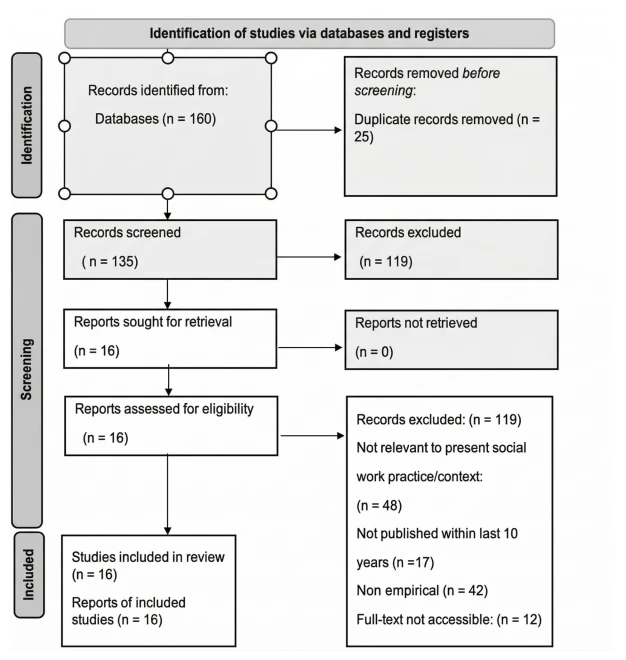
Key Findings and Discussions
Geographically, all selected studies were conducted in South Asian countries, with most focusing on Bangladesh and India. The studies also involved a wide range of participants, ranging from social work students, social work faculty members, field supervisors, social work practitioners, government officials, and representatives of non-governmental organizations (NGOs) (Ali et al., 2024; Bhusal & Larmar, 2024; Cleak et al., 2019; Jalil & Hussain, 2023; Pandya, 2015; Sharma, 2019; Stanley et al., 2018). Thematic analysis across the studies revealed ongoing challenges, including the dominance of Western models in social work curricula, lack of professional recognition, inadequate field placement training, limited funding opportunities, absence of standardized regulatory bodies and licensing frameworks. Thus, these findings suggest that the social work profession in South Asia is navigating a critical turning point, in which systemic challenges are being met through community resilience, culturally grounded practice, and innovative approaches across the region.
Professional Recognition and Identity Challenges
In South Asia, social work often lacks professional recognition and is frequently regarded as charity-based work rather than as a practice-based professional degree, with this perception being especially evident in Bangladesh (Jalil & Hussain, 2023). This challenge extends to countries like India, where social work faces an identity crisis due to an unclear definition and the absence of a standardized regulatory or educational framework (Baikady et al., 2020). In health care settings, social workers often experience difficulties, including role ambiguity, uncertainty, institutional constraints, and the dominance of the medical model and uneven professional standards (Cleak et al., 2019). In Bangladesh’s public sector, the Department of Social Services (DSS) prioritizes economic poverty alleviation over psychosocial and mental health needs, and many professionals responsible for service delivery do not have formal training in social work, which limits professional scope and adherence to core social work values (Jalil & Hussain, 2023). These problems reinforce the persistent structural and professional barriers that undermine the legitimacy and effectiveness of social work practice across South Asia, highlighting the urgent need for standardized regulation and professional recognition in social work education.
Gaps in Social Work Education and Field Practicum Components
Educational and field practicum components of social work programs across the region also continue to confront significant quality-related challenges. Specifically, field training and practicum are weakened by a lack of contextually relevant and indigenous curricula, insufficient professional supervision, limited opportunities for skill development, and the lack of well-established social work agencies that can offer meaningful practicum placements (Ali et al., 2024). In the Indian context, Open and Distance Learning (ODL) programs have expanded access to social work education, but they regularly face challenges related to technological barriers, limited faculty-student interaction, and inadequate monitoring of field placements, which raise questions about students’ professional competence upon graduation (Saumya, 2024). To address these persistent curricular gaps, a substantial proportion of social work educators in South Asia incorporated spirituality into social work curricula, acknowledging the importance of spiritual social work practice to promote practice that reflects local realities (Pandya, 2015). However, these initiatives remain constrained by a lack of institutional support and funding for curriculum development.
Impact and Adaptation During COVID-19
The COVID-19 crisis further exposed the structural weaknesses in social work education and practice in South Asia. In Bangladesh, teaching, learning, and research practices were severely affected by a rapid switch to a virtual platform, highlighting how digital media disproportionately affected rural students without reliable internet access and technology (Hossain & Ahmad, 2024). At the same time, the field practice was severely disrupted as many social service agencies suspended in-person operations. This prevented students from fulfilling their field requirements and gaining essential practice skills (Das et al., 2024; Jalil & Oakkas, 2024). Open and Distance learning (ODL) systems like the IGNOU framework in India played a crucial role in preserving educational continuity through multimedia delivery models, despite the model still facing difficulties with fieldwork validation and social stigma (Saumya, 2024). While the pandemic delayed academic progress across South Asia, it has also demonstrated the strong need for a more flexible, technologically integrated, and disaster-ready social work education system in the region.
Regulatory Frameworks and Licensing
Another major structural challenge facing social work across the region is the absence of common, unified regulatory bodies and national licensing systems, which has hindered the profession’s development, standardization, and recognition within the region and directly shapes what social workers can and cannot do in practice. These regulatory gaps led to uneven educational standards, weak enforcement of ethical guidelines, and poor career prospects. There is no formal mechanism to distinguish social work (BSW/MSW) graduates from other untrained personnel in social service organizations. This has left many social work graduates with limited access to formal social work positions. In Sri Lanka, efforts have been made to strengthen the professional status of social work by the establishment of statutory regulatory bodies such as the Sri Lanka Association of Professional Social Workers. This association has advocated for legislation to create a national regulatory authority, urging the support from policymakers and the wider social work community to improve the social work profession (Attanayake, 2016). In contrast, Pakistan continues to face significant barriers to professionalization, where Pakistan has remained disconnected with major international professional organizations, including the International Federation of Social Workers (IFSW), the International Association of Schools of Social Work (IASSW), and the International Council on Social Welfare (ICSW) which has reduced opportunities for global knowledge exchange and international collaboration (Das et al., 2023).
Lack of Financial and Mentorship Opportunities
Financial limitations remain an obstacle to the development of social work education and practice across South Asia. In Bangladesh, a lack of financial support has prevented academic institutions from producing social workers equipped to establish social work as a fully recognized profession, further constraining curriculum development (Mazid & Azam, 2023). Across South Asia, most of the academic institutions lack financial and institutional support to support research and training (Sharma & Razzaque, 2017). Mentorship is also lacking in the research projects due to the absence of a research culture, where young and early researchers struggle to advance their careers (Sharma & Razzaque, 2017). Due to the lack of professionals with social work qualifications, supervision is done by professionals having a limited understanding of social work roles and responsibilities (Jalil & Oakkas, 2024). These funding and mentorship gaps have left social work research and education under-resourced, which limits further professional abilities to build a strong and locally grounded social work practice in South Asia.
Workforce Adaptability and Emotional Intelligence
Beyond institutional and educational frameworks, the literature also demonstrates emotional intelligence, reflective capacity, and adaptability of the social work workforce within the region. Stanley et al. (2018) found that female social workers in the region possess strong levels of reflective abilities and emotional intelligence, which are important for addressing complex social challenges. This adaptability became more visible during the COVID-19 pandemic, when social workers went beyond their traditional roles to serve as a critical frontline force (Bhusal & Larmar, 2024; Das et al., 2024). Despite having limited resources, educators and practitioners have demonstrated a strong commitment to developing core competencies through creative and experiential learning strategies (Sharma, 2019).
Conclusion
The findings of this systematic review show that social work practice in South Asia is at an important turning point. The complexities include a persistent identity problem, limited professional recognition, gaps in curriculum development, funding constraints, and broader organizational constraints. To strengthen the field, it is essential to enhance professional regulations, integrate indigenous communal practices into the curriculum, improve the quality of field education, increase research capacity, and encourage cross-country collaboration. These steps will help build a social work identity that reflects South Asian local realities while staying connected to global developments.
References
Ali, I., Hossain, M. I., Islam, M. S., & Azman, A. (2024). Challenges of social work field practicum and professionalization in Bangladesh. Social Work Education, 1(44), 86–102. https://doi.org/10.1080/02615479.2024.2339468
Attanayake, M. T. R. S. (2016). Challengers of social work education in Sri Lanka. International Journal of Social Work and Human Services Practice, 4(5), 118–120. https://doi.org/10.13189/ijrh.2016.040504
Baikady, R., Cheng, S.-L., & Channaveer, R. M. (2020). Eight decades of existence and search for an identity: educators perspectives on social work education in contemporary India. Social Work Education, 40(8), 994–1009. https://doi.org/10.1080/02615479.2020.1773780
Bhusal, R., & Larmar, S. (2024). Social work responses to the COVID-19 pandemic in Nepal: Current practices and future considerations. Social Work in Public Health, 6(39), 522–533. https://doi.org/10.1080/19371918.2024.2346119
Cleak, H., Kr, A., Heaslop, G., & Tonge, A. (2019). Challenges to the development of a health care practice model for hospital social work in India. Social Work in Health Care, 2, 122–137. https://doi.org/10.1080/00981389.2020.1719566
Das, T. K., Mehta, B., Nikku, B. R., Omer, S., & Granich, S. (2023). Decolonizing South Asian social work: an analysis. Social Work Education, 42(5), 601–619. https://doi.org/10.1080/02615479.2022.2075843
Das, T. K., Paul, K., & Bhattacharjee, P. (2024). What happened to field practicum in social work education during COVID‐19? Evidence from Bangladesh. Asian Social Work & Policy Review, 18(1), 1–11. https://doi.org/10.1111/aswp.12294
Hussain, S., Farid, S., & Alam, A. (2023). Challenges and opportunities to the profession of social work in Pakistan: A review. Global Sociological Review, 8(2), 129–135. https://doi.org/10.31703/gsr.2023(VIII-II).14
Hossain, M. I., & Ahmad, I. (2024). Impacts of COVID‐19 on social work teaching and learning in Bangladesh. Asian Social Work & Policy Review, 18(2), 1–12. https://doi.org/10.1111/aswp.12315
Jalil, M. A., & Hussain, M. M. (2023). Challenges of practicing professional social work in Bangladesh: perspectives from public sector service providers. Asia Pacific Journal of Social Work & Development (Taylor & Francis Ltd), 33(3), 230–243. https://doi.org/10.1080/02185385.2023.2165538
Jalil, M. A., & Oakkas, M. A. (2024). Social Work Field Practicum in the Time of Social Distancing: A Case of Bangladesh. International Journal of Community & Social Development, 6(4), 454–469. https://doi.org/10.1177/25166026241275753
Moher, D., Liberati, A., Tetzlaff, J., Altman, D. G., & PRISMA Group. (2009). Preferred reporting items for systematic reviews and meta‑analyses: The PRISMA statement. PLoS Medicine, 6(7), e1000097.https://doi.org/10.1371/journal.pmed.1000097
Pandya, S. P. (2015). Including Spirituality in the Social Work Curriculum: Perspectives from South Asia. Social Work Education, 34(6), 729–746. https://doi.org/10.1080/02615479.2015.1043259
Pulla, V. R., Das, T. K., & Nikku, B. R. (2020). Indigenous or blended model for South Asian social work? Space and Culture, India, 8(1), 40–58. https://doi.org/10.20896/saci.v8i1.773
Riaz, S., & Granich, S. (2022). Professional development of social work education and practice in Pakistan within a global context. Social Work Education, 42(8), 1402–1417. https://doi.org/10.1080/02615479.2022.2032631
Saumya. (2024). Role and relevance of open and distance learning in social work education: case study of IGNOU, India. Social Work Education, 43(4), 970–989. https://doi.org/10.1080/02615479.2022.2159939
Shah, N. A. (2018). Social work education in Pakistan: Issues and future opportunities. Pakistan Journal of Applied Social Sciences, 7(1), 1–15. https://doi.org/10.46568/pjass.v7i1.315
Sharma, M., & Razzaque, B. (2017). Research capacity strengthening in South Asia: Based on the experience of South Asian Hub for Advocacy, Research and Education on Mental Health (SHARE). Global Mental Health, 4, e9. https://doi.org/10.1017/gmh.2017.5
Sharma, S. (2019). Using Observation as Method of Data Collection to Enhance Empathy and Critical Reflection Amongst Students of Social Work. Hong Kong Journal of Social Work, 53(1/2), 35–45. https://doi.org/10.1142/S0219246219000068
Stanley, S., Buvaneswari, G., & Meenakshi, A. (2018). Predictors of empathy in women social workers. Journal of Social Work, 1(20), 43–63. https://doi.org/10.1177/1468017318794280
World Population Review. (2026). Southern Asia Population 2026. https://worldpopulationreview.com/continents/southern-asia