






Social Work Education towards the 2030 Agenda for Sustainable Development: a Student Account from Germany
The 2030 Agenda for Sustainable Development and its Goals (SDGs) offer a human rights- based agenda for change that balances economic development, social justice and environmental sustainability. This article wants to show their relevance for social work education (1). It will then describe a transnational study program that reflects these goals (2) and suggest an SDG-sensitive curriculum for the years to come (3).
The Relevance of SDGs for Social Work
The people centered SDGs reflect on many fields of social work. The reduction of poverty and hunger, social inclusion, namely access to education, social and health services, countering discriminatory practices, policies and laws, especially gender inequalities, are at the core of social work efforts. In addition, social work always promoted peaceful and inclusive societies, access to justice and accountability as well as global partnerships. In its policy paper from April 2021 the International Federation of Social Workers (IFSW) recognizes the goals as an opportunity for global transformation in social, economic and ecological aspects. Social work could take the role of a partner on international level as well as facilitator of partnerships within communities and various stakeholders. The paper emphasizes a social work approach from bottom-up (community and people driven) that gravitates around the knowledge and needs of the people (IFSW 2021).
Pandey and Kumar (2018) see the need to therefore create awareness about global concerns at the local levels and ensure participation in collective action (p. 200). This will need adjustments to curricula as "social workers need to be equipped with skills and competencies required to handle the concerns of SDGs while they work with target communities" (p. 194). According to Pandey and Kumar such a curriculum should include key sustainable development issues like climate change, disaster risk reduction, biodiversity issues, poverty reduction, sustainable livelihood opportunities and sustainable consumption (p. 202). While social work has to be located within a national framework and must be specific to the local situation or context, social workers will be instrumental in creating an enabling environment for ensuring that the local needs interface with the SDGs (p. 202). This approach would call for dynamic interactions between educators, practitioners and social work organizations as well as more involvement in policy planning (p. 204).
2. Transnational Social Work at Frankfurt University of Applied Sciences
The program at Frankfurt University of Applied Sciences that we describe in this article uses the name Transnational Social Work pointing to the fact that Social Workers are confronted with people who are embedded in transnational processes such as crossing physical borders, communicating across borders, in more than one language, carrying many local and hybrid identities etc. (Schwarzer 2016).
The transnational social work program at Frankfurt University of Applied Sciences was introduced in the year 2013 (www.frankfurt-university.de/transnational). The program wants to equip social workers with the knowledge and understanding, the methods and professional ethics to work with people who migrated or fled to Germany. Thus, the (legal) framework is still national, but the perspective is trans-national. The program is based on the requirements of the German qualification-framework for social work. It intends to impart the following skills: knowledge and understanding of global context as well as processes of inclusion and exclusion; foundations of transnational social work and finally project-management skills, language proficiency and ability to work in multi-cultural and interdisciplinary teams.
Many of the topics of the program take up relevant SDGs and are designed for the world envisioned by the Global Agenda beyond 2023. Several modules evolve around social inequalities, discrimination and social justice; others investigate migration law, policies and research, and the mental stress that comes with migration. Access to education is at the heart of social pedagogy, that is social work with children, youth and families. The support for victims of violence, namely child protection and violence against women, is also covered. Poverty and hunger are discussed from a global perspective, and international law and institutions as well as development cooperation are explained.
Student's views are expanded during an Erasmus-semester at one of the program's European partner-universities (2nd year), an internship in Germany (3rd year) and a practical placement outside of Europe (4th year). An integral part of the program is a continuous reflection to deliberate on privileges, power-relations as well as the structural and political context, thus facilitating a non-oppressive approach and civil engagement. The mandatory semester abroad introduces students to the social and societal order of another EU-country, it's social problems and social policies, social services and support systems. For our Erasmus-semester we studied in Denmark, France, the Netherlands and Turkey. Even so our host countries have systems of social protection in place around 20% of their population, many migrants, are considered being 'at risk of poverty or social exclusion' because of monetary poverty, severe material and social deprivation or very low work intensity; rates in Türkiye being even higher (Eurostat 2023, p. 47, 200). This has consequences for accessing health services or affordable housing etc. Moreover, the European Union is moving away from combatting climate change and its impacts, with CO2-emissions per capita being amongst the highest on the globe (Eurostat 2023, p. 11). The internship in Germany opens various options: Our internships took place in homes for unaccompanied minor refugees, with the youth migration service (which helps with educational and labor-market integration), and at a counseling center for migrant women and their families. This describes best the transnational focus of the social support system in Germany.
International practice placements (preferably in Non-European countries) take place in recognized services abd are accompanied by supervision to reflect on culturally different working environments and transnational cooperation. Wehbi (2009) has pointed out that students' motivations for international placement are diverse and sometimes questionable. Learning about 'other' cultures, opening new horizons, extending personal and professional networks are some of the reasons given (Cleak et al. 2016, p. 5). At the same time new fields of practice become available such as working on the alleviation of poverty, responding to natural disasters, working in refugee camps etc. Currently, we are placed in a women's rights organization in Uganda, and with a refugee support service and in a mental health clinic in Malaysia. We hope to have more insights into community-based support systems, and to be equipped to lobby for the SDGs when returning home.
When asked, students report having to cope with new and unexpected situations while studying and living in a foreign country. A literature review of the last two decades indicates that students experience culture shocks and otherness and start questioning their western beliefs and privileges (Ali et al. 2022, pp. 17). This allows students to relate to feelings normally expressed by minorities, which makes them, hopefully, more sensitive to the biographies of their clients, and into advocates for social change and inclusiveness in future.
We also had an opportunity to participate in an international week and a transnational summer school that included partner universities from Europe, but also India, Malaysia, Marocco, Namibia and South Africa. This short-term, in person programs allow for better understanding of diverse realities and facilitates transnational interactions and teamwork. A recent example was a four-university writing workshop on inequalities within and among countries. The workshop was preceded by two online courses to introduce SDGs and theories of social inequality and to prepare participants' own writing project. Posters were presented at the International Malaysian Studies Conference. When reflecting on their learning experiences, participants highlighted the link of their own research with the SDGs, and the interconnectedness of targets dealing with inequalities and equal opportunities.
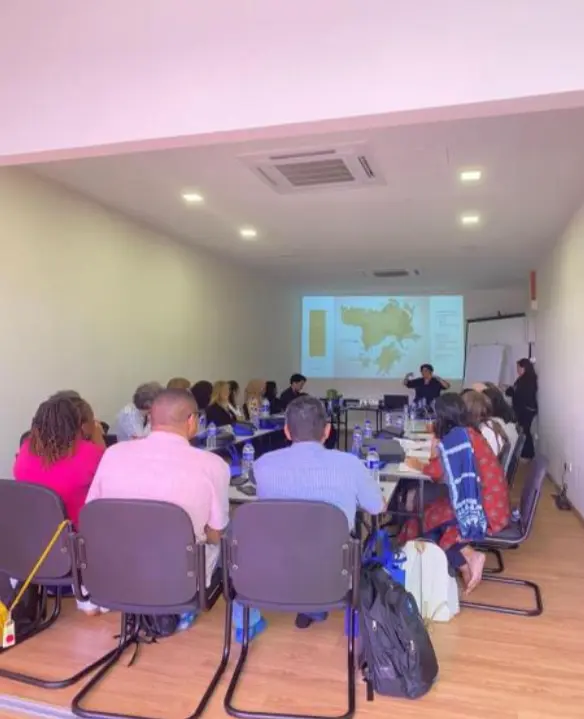
They understood the relevance of working with marginalised and vulnerable groups, and how inequalities play out in different countries and contexts. Networking in achieving the global goals was considered a crucial factor.
3. Conclusions and Recommendations
We want to conclude this article with recommendations for social work education that values the 2030 Agenda for Sustainable Development:
- Following the suggestion from Wehbi (2013) 'core critical knowledge areas' should be identified (p. 229) - and SDG 10: inequalities within but also among countries should become one of those areas. Students will then gain knowledge to be able to contribute to the main SDG-targets: reduce income inequalities, inclusion and equal opportunities for all, end discrimination, and impact on social policies that promote equality and responsible migration policies.
- Curricula often adopt material from Western, mainly Anglo-American sources and adapt them to reflect the local context and requirements (Pandey & Kumar 2018, p. 202). We suggest that more publications from the Global South should be integrated into 'western' classrooms. One such example is the South African Ubuntu philosophy which fosters connections and responsibilities among individuals, families, communities, and the environment (Van Breda 2019). Ubuntu could lead to an eco- social approach to social work by embracing indigenous concepts, treating the Earth as a vital community member rather than a mere resource.
- Indigenous concepts can also pave the way to reflect on climate change and environmental implications that pose unprecedented threats to the globe and to society. The urgency is reflected in several Sustainable Development Goals, namely SDG 11, 12, 13, 14, 15. As the definition of Social Work highlights: "Social Work intervenes at the points where people interact with their environments" and deals with the social effects of environmental and climate crises (IFSW-IASSW 2014). Therefore, environmental justice and sustainability should become an integral part of social work curricula - from content to practice to professional ethics and advocacy.
- These changes also must acknowledge the necessity of collaboration across borders (SDG 17) and encourage ways of peaceful transformation for justice and equity (SDG 16).
References
Ali, Wasif et al. (2022): The Shifting Landscape of International Practicum in Social Work Education.
In: IJSW 9 (1), p. 1. Download under:
www.macrothink.org
Cleak, Helen; Anand, Janet; Das, Chaitali (2016): Asking the Critical Questions: An Evaluation of Social
Work Students' Experiences in an International Placement. In: Br J Soc Work 46 (2), p. 389-408.
Download under:
www.researchgate.net
Eurostat (2023): Sustainable development in the European Union — Monitoring report on progress
towards the SDGs in an EU context (2023 edition). Hg. v. Ekkehard Petri (Eurostat, Unit E2 -
Environmental statistics and accounts und sustainable development). Luxemburg. Download under:
ec.europa.eu.
International Federation of Social Workers (2014): Globalisation and the environment. Download
under: www.ifsw.org.
International Federation of Social Workers (2021): Social Work and the United Nations Sustainable
Development Goals (SDGs). Download under: www.ifsw.org.
Pandey, Umesh Chandra; Kumar, Chhabi (2018): A SDG Compliant Curriculum Framework for Social
Work Education: Issues and Challenges. In: Walter Leal Hg Filho (Hg.): Implementing Sustainability in
the Curriculum of Universities. Approaches, Methods and Projects. Springer (World Sustainability
Series), p. 193-206. Download under:
ndl.ethernet.edu.et.
Schwarzer, Beatrix (2016): Transnational social work: an introduction. In: Schwarzer, Beatrix;
Kämmerer-Rütten, Ursula; Schleyer-Lindenmann, Alexandra; Wang, Yafang (Hg.) (2016): Transnational
Social Work and Social Welfare: Routledge, p. 4-12. Download under:
www.taylorfrancis.com.
Van Breda, Adrian D. (2019): DEVELOPING THE NOTION OF UBUNTU AS AFRICAN THEORY FOR SOCIAL
WORK PRACTICE. In: Social Work/Maatskaplike Werk 55 (4), p. 439-450. Download under:
www.researchgate.net.
Wehbi, Samantha (2009): Deconstructing motivations: Challenging international social work
placements. International Social Work, 52(1), p. 48-59. Download under: Deconstructing motivations:
Challenging international social work placements - Samantha Wehbi, 2009 (sagepub.com)
Wehbi, Samantha (2013): Challenging International Social Work Placements: Critical Questions,
Critical Knowledge. In: Decolonizing Social Work: Ashgate, p. 223-238. Download under: Decolonizing
Social Work - 1st Edition - Mel Gray - John Coates - Mich (routledge.com)
.
Acknowledgement
This article was written as part of the transnational IWAAC-10 writing workshop from August 7 to August 12, 2023, in Malaysia under the guidance of Prof. Nicolette Roman, University of the Western Cape, South Africa. We want to thank all the participants for their supportive presence, feedback, input and critical questions. For further information on the project see: www.frankfurt-university.de/IWAAC-10.