
Introduction
Currently, social work training programs at the Ibero-American level focus, in some cases, only on the generation of professional skills centered on social intervention and others. Towards the production of knowledge that legitimately contests its own field of problems. In this latter scenario, there is also no homogeneity in the level of complexity from which epistemological resources are applied. A review of what has occurred in Ibero-American countries with a tradition in the teaching of Social Work reveals significant differences.
In countries like Spain and Colombia, this knowledge is incorporated into other curricular activities. In Spain, for example, the curriculum at the Complutense University of Madrid does not include a specific module on epistemology, although it does include basic subjects such as sociology, statistics, and political science. A very similar situation exists in the curriculum at the University of Castilla-La Mancha, where first-year students review "Introduction to Social Work," "Law," and "Political Science," but not epistemology.
In Argentina, at the University of Buenos Aires, the curriculum includes a second cycle called the "General Education Track," which provides elements for approaching relevant classical theories. It comprises seven courses, including "Epistemology of the Social Sciences." At the National University of Cuyo, in their second year, students take "Epistemology of the Social Sciences" concurrently with "Methodology and Techniques of Quantitative and Qualitative Research," which, surprisingly, does not make it a mandatory prerequisite. Finally, at the National University of San Juan, students take "Epistemology of the Social Sciences" in their second year along with "Social Work with Groups," "Group Practice," "Sociological Theory," and other courses.
In Colombia, at the National University, students take a course called "Epistemology of Research in Social Work" in their first year, along with others such as "Social Problems I" or "Contemporary Colombia," while at La Salle University they take "Epistemology of the Social Sciences" in their first year, also along with courses such as "Mathematics," "Culture, Territory and Everyday Life," "Theories of the Subject and Popular Education," and "Critical Pedagogies," among others.
In Peru, the National University of San Marcos, which states its objective as training “critical social scientists characterized by their analytical rigor,” replaced the “Epistemology of the Social Sciences” course in the 2009 curriculum with “Introduction to Science.” In the second semester, they added “Introduction to Scientific Research,” and in the third semester, “Introduction to the Social Sciences.” At the National University of the Center (UNCP), the Social Work program includes the course “Epistemology” in the first semester; however, it is not specified whether it is oriented toward research or intervention, or whether it refers to the social sciences in general. At the Inca Garcilaso de la Vega University, no curricular activity related to epistemology is included. The same occurs in the Social Work program at the National University of San Agustín in Arequipa, which includes “Introduction to Social Research” in its second semester, but not epistemology.
In the Chilean case, it is unthinkable not to incorporate epistemology into the curriculum of university schools of Social Work, given the research skills required to obtain a Bachelor's degree in Social Work. Even so, a divergence of approaches is evident. On the one hand, there is a certain orientation towards the generic teaching of epistemology applied to the social sciences, and some courses are even called "epistemology of Social Work" as if it were knowledge exclusive to the discipline and generated within the discipline itself. The teaching of specific courses in this area, generally in the first years of study, demonstrates the significant relative weight given to this acquired knowledge in Chilean university Social Work education, likely associated with obtaining a Bachelor's degree 1.
The importance of choosing a particular epistemological approach—be it positivist, interpretivist, critical, or post-positivist—is not a trivial matter: it involves political decisions regarding what kind of knowledge is considered legitimate in an educational project and defines which researchers have the ability to demonstrate what they know and say about reality. In a 2016 study by the author of this paper, entitled “Epistemological Sustainability in University Social Work Education in Chile: An Exploratory Approach from the Perspective of Complex Systems” (in translation), after surveying 51 academics from 26 university-level Schools of Social Work and triangulating the results with 10 interviews with Chilean academics and documents, it was observed that most participants were flexible in teaching different types of epistemological paradigms to students, who would ultimately decide which one to apply, in a context otherwise characterized by low epistemological control by the professional practice system. Only in some training projects, mainly from public universities with teachers whose days are dedicated to research, is there a greater focus on this type of resource.
This study introduces, for the first time, the concept of “epistemological sustainability” as a dimension of educational projects. It argues that Social Work as a discipline can be understood by its capacity for self-reproduction and for establishing formal mechanisms for its continuity, adaptation, and growth, thereby defining its disciplinary boundaries and scientific identity. The research findings reveal a significant orientation toward phenomenological or constructivist frameworks in theses, a strong inclination toward the use of qualitative tools, low circularity of knowledge generated by students and professors both internally and externally, a concerning lack of understanding of epistemological resources among students, and the growing enrollment in non-university Social Work programs in Chile, which may represent a risk factor for scientific research training. Thus, the complex system known as Social Work continues to depend on external inputs from a disciplinary field called epistemology, coupled with a poor understanding of the research process and a significant lack of dialogue between its own knowledge and that of other disciplines and institutions.
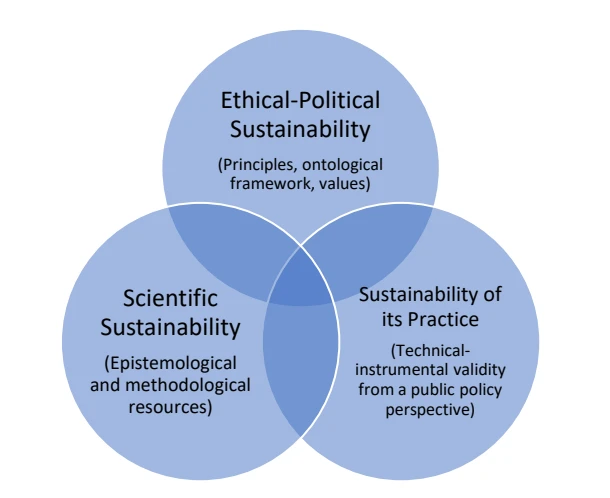
As shown in Figure 1, the sustainability of Chilean Social Work depends on three dimensions. In the Chilean case, there is strong ethical and political sustainability inspired by the historical framework of defending and promoting human rights and guaranteeing democratic coexistence. Sustainability in practice is evident in the State's significant appreciation of the professional role as an implementer of public policies. However, it is in epistemological sustainability where we believe the continuity of the disciplinary project is at risk.
As reviewed in this paper, Social Work in other countries of the region has a strong inclination towards a daily, methodological, and contextual approach, probably more focused on "doing." We believe that if the knowledge generated in Social Work schools is not used or reused in the same training projects, and if there is also low epistemological control in the environment, the premise of "self-reproduction" and the systemic mechanisms for its continuity and growth are not met.
Social work education in Chile faces a complex situation. According to data from the Ministry of Education (MINEDUC, 2026), 3,627 students graduated from professional institute programs in 2024, surpassing the 3,162 university graduates. This suggests that the labor market is not distinguishing between graduates with a bachelor's degree (university graduates) and graduates of professional institutes (those with a professional background). While the former obtained their degree in 9.2 years in real time, university graduates did so in 11.3 years, which can evidently act as a disincentive to university training in Social Work, even more so considering that the employability in the fourth year of a graduate from a Professional Institute is 75.3% and that of a University graduate is 78.4%, with no significant differences in this respect (MINEDUC, 2026). In other words, the scientific nature of Social Work would be at risk with a strong threat to the epistemological sustainability of projects in a scenario of legal and professional deregulation of the profession. According to some authors, such as Malacalza (1994) and Díaz (2025), a weakness in the mastery of social theory and epistemological reflection leads to reductionist analyses of the social, preventing the recognition of complexity as an inherent dimension of all professional practice. This critique aligns with the perspective of Veras Baptista (1992), who emphasizes that professional intervention cannot be separated from a structural understanding of the social conditions that shape it (cited in Díaz, 2025).
References
National Accreditation Commission https://www.cnachile.cl/Paginas/buscador-avanzado.aspx
Díaz Ortega, M. (2025). The relationship between research and professional intervention in the training process of Social Workers. Rumbos TS , 20 (35), 231-261. Electronic publication December 5, 2025 https://dx.doi.org/10.51188/rrts.num35.1045
Government of Chile, Law No. 20.054 Amends Law No. 18.962, Re-establishing the university exclusivity of Social Work, 2005
Government of Chile, Constitutional Organic Law of Education No. 18,962, 1990
Malacalza, S. (1994). Research in Social Work: Some reflections. Social Work Journal (64), 75-80. https://revistatrabajosocial.uc.cl/index.php/RTS/article/view/80252 [ Links ]
Complutense University of Madrid, Castillo La Mancha, accessed on May 20, 2026 https://www.uclm.es/estudios/grados/trabajo-social
Complutense University of Madrid, accessed on May 20, 2026 https://www.ucm.es/estudios/grado-trabajosocial-estudios-estructura
National University of San Juan, accessed on May 20, 2026 https://www.facso.unsj.edu.ar/departamentos/departamento/26
National University of Cuyo, accessed on May 21, 2026 https://fcp.uncuyo.edu.ar/upload/plan-de-estudios-de-lic-trabajo-social1.pdf
Notes
1Law No. 20.054 of 2005 in Chile restored university status to Social Work, after it had been downgraded in 1990. This Law allows universities to grant the title of Social Worker with a Bachelor's Degree, while maintaining the possibility that professional institutes may grant the title of Social Assistant, generating a mixed scenario without full university exclusivity. According to Law No. 18,962, universities may grant professional titles and all types of academic degrees, especially Bachelor's, Master's, and Doctoral degrees. A Bachelor's degree is awarded to a university student who has successfully completed a program of study encompassing all the essential aspects of a specific area of knowledge or discipline. ↩