
Introduction
The contemporary landscape of professional social work is fundamentally dictated by a 'glocal' paradigm, an analytical framework where transnational macroeconomic and ecological shifts directly necessitate and reshape localised community interventions. A glocal analysis is required to understand how global vulnerabilities are systematically transferred into regional policy frameworks and micro-level practice realities.
According to the United Nations Department of Economic and Social Affairs (UN DESA) in the World Social Report 2025, global economic precariousness has reached critical thresholds. It is documented that approximately 60% of the global workforce expresses acute fear of employment loss and the wealthiest 1% of the global population has consolidated more wealth than the bottom 95%.1 These macro-structural inequities do not remain abstract; they precipitate localised crises such as community fragmentation, the depletion of municipal welfare budgets and a heightened demand for direct psychosocial interventions at the grassroots level.
In response to these systemic fractures, the International Federation of Social Workers (IFSW) established the 2026 World Social Work Day agenda under the mandate, "Co-Building Hope and Harmony: A Harambee Call to Unite a Divided Society".2 This global directive, scheduled for formal recognition at the United Nations Office in Geneva on 18 March 2026 with an address by IFSW President Joachim Mumba, demands a structural transition from individualised charity towards macro-level systems change.3 It emphasises that transnational crises must be countered through decentralised, community-led solidarity mechanisms.
Consequently, micro-level social work interventions can no longer be conceptualised in isolation from global socio-economic paradigms. The subsequent sections of this article systematically deconstruct how these global structural pressures are translated into regional challenges across South Asia and how they explicitly manifest within the administrative and demographic frameworks of Kerala, India.
Global Issues – Climate Displacement and Digital Welfare Divides
Building upon the glocal framework established in the preceding section, it is imperative to examine the specific transnational challenges currently destabilising community structures worldwide. Foremost among these are the escalating rates of climate-induced displacement and the structural inequities generated by the digitisation of welfare delivery systems.
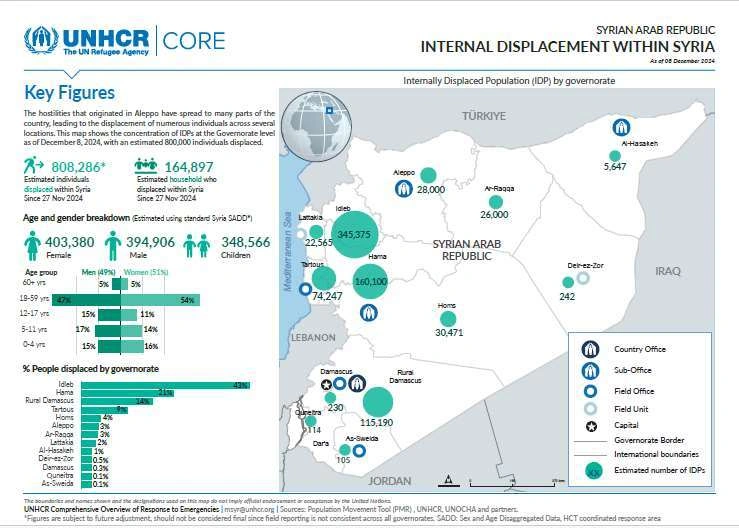
The intersection of ecological degradation and human mobility has necessitated the rapid integration of 'Eco-Social Work' into international practice. According to the Global Report on Internal Displacement (GRID) 2026, published by the Internal Displacement Monitoring Centre (IDMC) on 12 May 2026, an unprecedented 82.2 million individuals were living in internal displacement globally by the end of 2025.4 While conflict remains a primary driver, the report documents that nearly 13.6 million of these displacements were directly triggered by natural disasters and climate-related crises. Furthermore, the United Nations High Commissioner for Refugees (UNHCR) Global Trends Report, released in June 2026, indicates that 117.8 million people are now forcibly displaced worldwide.5 These figures demonstrate that climate displacement is a central, systemic crisis requiring macro-level policy advocacy and robust, cross-border resettlement frameworks.
Concurrently, the global transition towards digital public infrastructure has inadvertently created a new dimension of vulnerability: digital welfare stratification. As governmental bodies increasingly automate social security and relief delivery, algorithmic bias and digital exclusion exacerbate pre-existing inequalities. It is observed that populations lacking digital literacy, broadband infrastructure, or formal identification are systematically disenfranchised from state support mechanisms. This digitisation of welfare mandates a critical shift in macro-social work, requiring professionals to advocate for digital rights and equitable inclusion within algorithmic governance structures.
Regional Issues – South Asia and India
Transitioning from transnational digital disparities to regional resource allocation, the South Asian context, specifically India, presents a dual challenge of epistemological transition and structural welfare deficit. In alignment with the mandates of the National Education Policy (NEP) 2020, Indian social work academia is currently undergoing a systemic epistemological decolonisation. This policy shift necessitates the dismantling of Eurocentric pedagogies in favour of indigenous, community-centric theoretical frameworks that address localised socio-cultural realities.
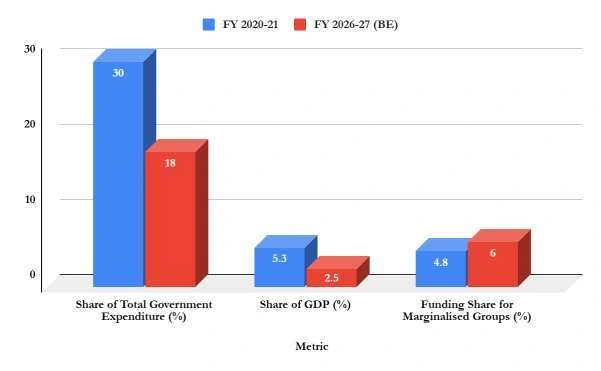
However, this progressive academic restructuring is directly juxtaposed against a critical macro-structural contraction in state-sponsored welfare. An analysis of the Union Budget 2026-27 indicates that while social sector expenditure is estimated at ₹9.8 lakh crore, it has structurally declined as a proportion of total government expenditure, dropping from 30% in FY 2020-21 to merely 18% in FY 2026-27 Budget Estimates.7 Concurrently, total social spending as a share of the Gross Domestic Product (GDP) has fallen to 2.5%.
This reduction in direct macroeconomic provisioning necessitates the rapid privatisation of welfare services, which disproportionately impacts historically oppressed demographic groups. Recent fiscal data demonstrates that between 2019-20 and 2024-25, funding explicitly targeting vulnerable groups, including Dalit and Adivasi populations, accounted for less than 5% of total social sector expenditure, with only a marginal projected increase to 6% in 2026-27.8 As the state withdraws, privatised welfare models commodify essential services, thereby entrenching the structural marginalisation of indigenous (Adivasi and Dalit) communities who lack the economic capital to participate in market-based social security systems.
Local Issues – Demographic Transitions in Kerala
This contraction of macro-level state support is particularly consequential when observed through the lens of specific demographic transitions at the sub-national level. The southern Indian state of Kerala presents a unique glocal challenge, characterised by an advanced demographic transition and a simultaneous, massive influx of inter-state migrant labour. These dual phenomena exert unprecedented structural pressure on the state's decentralised welfare apparatus.
Kerala’s population is ageing at an accelerated rate relative to the rest of the subcontinent. According to data analysed by the Kerala State Planning Board, individuals aged 60 and above constituted 16.5% of the total state population in 2021, with projections indicating an increase to 22.8% by 2036.9 This transition signifies that the demographic dividend is rapidly waning, resulting in a high old-age dependency ratio that necessitates expansive geriatric care networks.
Simultaneously, the state's economic infrastructure is heavily sustained by inter-state migrant workers. Research synthesised from the Centre for Development Studies (CDS), Thiruvananthapuram, estimates the migrant labour population in Kerala at approximately 3.5 to 4 million individuals, primarily arriving from states such as West Bengal, Assam and Bihar.10 This demographic replacement creates a complex administrative paradox: the local population requires extensive, long-term care facilities, while the transient migrant workforce requires immediate, accessible social security, housing and linguistic inclusion.
Consequently, the burden of managing these parallel crises falls disproportionately upon Local Self-Government Institutions (LSGIs) and the state poverty eradication mission, Kudumbashree. However, as federal allocations diminish, these decentralised bodies are tasked with addressing transnational-scale problems, such as internal labour migration and demographic shifts, without commensurate macroeconomic support. It is determined that local social work practice in Kerala must pivot towards capacity building within LSGIs, ensuring that decentralised welfare structures are fiscally and operationally equipped to manage this dual demographic reality.
| Year | Percentage of Population Over 60 (%) | Estimated Inter-State Migrant Labour Influx (Millions) |
|---|---|---|
| 2011 | 12.6 | 2.5 |
| 2021/2022 | 16.5 | 3.5 |
| 2036 (Projected) | 22.8 | 4.8 |
Note. A statistical representation of Kerala's dual demographic shift. The data illustrates a rapidly ageing indigenous population juxtaposed against a steady, high-volume influx of inter-state migrant workers. This intersecting trend places acute operational pressure on Local Self-Government Institutions to concurrently deliver geriatric care and migrant welfare services.
Conclusion and Policy Implications
The preceding glocal analysis establishes that contemporary social work crises, ranging from transnational climate displacement and digital welfare stratification to the localised demographic pressures observed in Kerala, are not isolated phenomena. Rather, they represent interconnected manifestations of macro-structural inequality and macroeconomic withdrawal from social provisioning. Resolving these challenges requires a definitive departure from individualised remediation towards systemic, macro-level policy reform.
Based on the empirical evidence reviewed, the following actionable policy implications are articulated for integration into social work academia and professional practice:
First, within academic structures, the epistemological transition necessitated by the National Education Policy 2020 must be fully institutionalised. University curricula are required to formally integrate 'Eco-Social Work' and digital rights advocacy. This structural update ensures that practitioners are methodologically equipped to assess and mitigate the impacts of climate-induced displacement and algorithmic bias in welfare delivery systems.
Second, at the regional policy level, federal resource allocation must be immediately recalibrated. The documented decline in social sector expenditure must be reversed to halt the rapid privatisation of basic welfare services, a trend that systematically disenfranchises historically oppressed Dalit and Adivasi communities.
Finally, regarding local practice, decentralised administrative bodies, specifically Kerala’s Local Self-Government Institutions (LSGIs) and the Kudumbashree mission, require enhanced, direct fiscal transfers from the state and central governments. Financial capacity building is strictly required to enable these grassroots institutions to manage their dual demographic mandate: expanding extensive geriatric care networks for an ageing indigenous population, while simultaneously establishing accessible housing and social security mechanisms for the massive influx of inter-state migrant workers.
It is concluded that professional social work can only realise the International Federation of Social Workers’ 2026 mandate for structural change by operating firmly at the intersection of macro-policy advocacy and decentralised, well-funded community action.
Footnotes
- UNU-WIDER, "World Social Report 2025 Sounds Alarm on Global Social Crisis," April 24, 2025 ↩
- International Federation of Social Workers, "World Social Work Day 2026," accessed June 15, 2026 ↩
- International Federation of Social Workers, "World Social Work Day 2026 at the United Nations in Geneva," February 19, 2026 ↩
- Internal Displacement Monitoring Centre, 2026 Global Report on Internal Displacement (GRID), May 12, 2026 ↩
- UNHCR, "Figures at a Glance," accessed June 15, 2026 ↩
- UNHCR, "Internal Displacement Within Syria," December 8, 2024 ↩
- ResGov, Union Budget Insights 2026–27, 2026 ↩
- Avani Kapur, Sharad Pandey and IndiaSpend, "Budget 2026: Big Schemes, Bigger Gaps in Social Spending," India Development Review (IDR), February 11, 2026 ↩
- Avani Kapur, Sharad Pandey and IndiaSpend, "Budget 2026: Big Schemes, Bigger Gaps in Social Spending," India Development Review (IDR), February 11, 2026 ↩
- Benoy Peter, Shachi Sanghvi and Vishnu Narendran, "Inclusion of Interstate Migrant Workers in Kerala and Lessons for India," The Indian Journal of Labour Economics 63, no. 4 (2020): 1065–1086 ↩
References
Foundation for Responsive Governance. (2026). Union budget insights 2026-27 (Vol. 3). https://www.resgov.org/contents/reports/138_Union%20Budget%20Insights%202026-27.pdf
India Development Review. (2026). Budget 2026: Big schemes, bigger gaps in social spending. https://idronline.org/article/advocacy-government/budget-2026-big-schemes-bigger-gaps-in-social-spending/
Internal Displacement Monitoring Centre. (2026). Global report on internal displacement 2026. https://www.internal-displacement.org/global-report/grid2026/
International Federation of Social Workers. (2026a). World Social Work Day 2026. https://www.ifsw.org/social-work-action/world-social-work-day/world-social-work-day-2026/
International Federation of Social Workers. (2026b). World Social Work Day 2026 at the United Nations in Geneva. https://www.ifsw.org/world-social-work-day-2026-at-the-united-nations-in-geneva/
Kerala State Planning Board. (2021). Mainstreaming the welfare of parents and senior citizens in Kerala. Government of Kerala. https://spb.kerala.gov.in/sites/default/files/inline-files/MAINENDWLFREPARENTSSRCITIZENSKr_1.pdf
Peter, B., & Narendran, V. (2020). Inclusion of interstate migrant workers in Kerala and lessons for India. The Indian Journal of Labour Economics, 63(4), 1065–1086. https://pmc.ncbi.nlm.nih.gov/articles/PMC7659401/
United Nations High Commissioner for Refugees. (2025). Global internal displacement data. https://data.unhcr.org/en/documents/details/113019
United Nations High Commissioner for Refugees. (n.d.). Figures at a glance. https://www.unhcr.org/about-unhcr/overview/figures-glance
United Nations University-WIDER. (2025). World social report 2025 sounds alarm on global social crisis. https://www.wider.unu.edu/news/world-social-report-2025-sounds-alarm-global-social-crisis