
The Liberatory Praxis of Winnie Madikizela-Mandela:
Political Resistance Through a Social Work
Lens
Introduction
In the political history of South Africa, few figures stand as prominently, and as controversially, as Ms. Winnie Madikizela-Mandela. Most of the world knows her as a militant leader in the African National Congress, the defiant wife of Nelson Mandela, and the “Mother of the Nation.” However, beneath this iconic image lies an often overlooked truth: Winnie Mandela was a professionally trained and practicing social worker. Her training in the discipline of social work grounded her activism and gave her a lens for seeing, challenging, and reimagining the injustices of apartheid South Africa (Hassim, 2018). In the context of contemporary social work challenges throughout the globe, such as increasing authoritarianism, economic inequality, and attacks on democracy, Winnie Mandela’s radical approach to political resistance offers important lessons for reclaiming the profession’s foundational commitment to justice, human rights, and emancipation. Her example demands a reexamination of how social work can function as a vehicle for political and social change in oppressed communities.
Social Work in a System of Injustice
Winnie Mandela received her degree in social work in 1956 from the Jan Hofmeyr School of Social Work, a training institution for Black social workers during apartheid, where she studied alongside other pioneers committed to addressing the urgent needs of oppressed South Africans (Bezdrob, 2003). Upon graduation, she became the first Black medical social worker at Baragwanath Hospital in Johannesburg, where she conducted community-based research into infant mortality in the townships, a grim indicator of systemic neglect and racialized public health disparities (CSWE, n.d.). Her findings, which revealed abnormally high infant death rates, highlighted the structural violence inflicted on Black communities and ignited her transition from social work into political resistance. Her role in the hospital exposed her to the everyday suffering of families under apartheid, which shaped her understanding of social injustice as institutional failure. These encounters strengthened her commitment to challenging the very systems responsible for such disparities.
This transformation was not unique, but ubiquitous. Social work in apartheid South Africa was inherently political. As Young (1980) and Nayoo et al. (2021) explained, the profession operated within and often under the constraints of a white supremacist regime, where state-sponsored welfare programs reinforced racial hierarchies. Yet, some practitioners, like Mandela, rejected complicity and moved toward a more radical, liberation-focused praxis. In doing so, she exemplified what Zimba (2024) described as "radical social work" in South Africa, a framework that resisted neutrality in favor of political and moral clarity in unjust systems.
Liberatory Social Work in Action
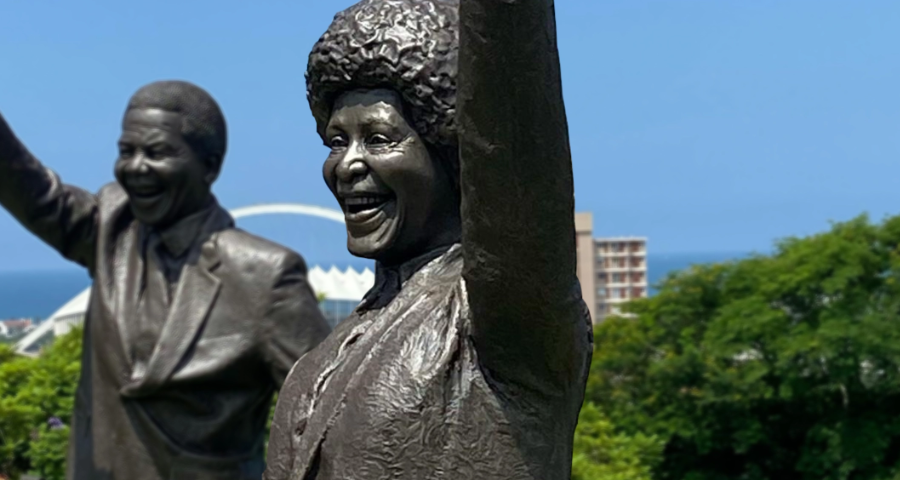
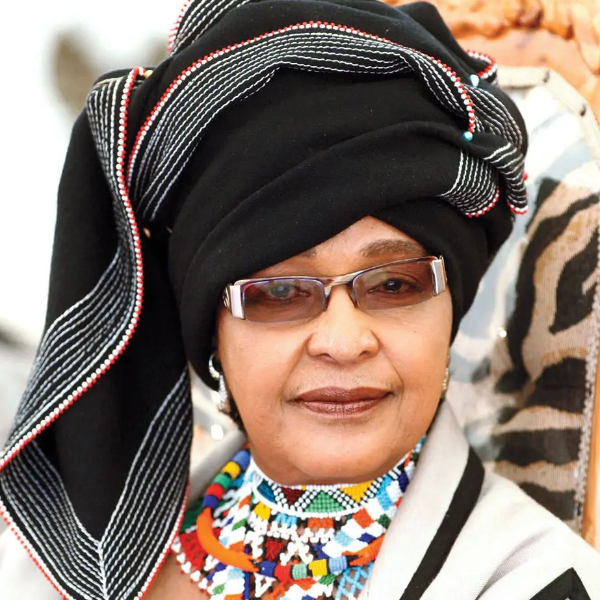 Image: Thambalwam23 / Creative Commons
Mandela's social work training equipped her with tools of empathetic listening, assessment, and systems analysis, skills she adapted to the political context. Her early work in community health laid the foundation for broader activism. In Brandfort, where she was banished for eight years, Mandela established clinics, youth centers, and literacy programs despite surveillance and harassment (South African History Online, 2024).
Her methods reflected what Kumalo (2022) called a form of “pastoral caregiving,” in which community engagement, advocacy, and direct service merged into a new model of political social work. These interventions were grounded in the belief that healing and empowerment are collective acts. Rather than retreat from her professional roots, she expanded them to meet the demands of resistance. Her efforts were not confined to conventional social service delivery but actively resisted the conditions that made such services necessary. This commitment echoes the vision articulated by Ioakimidis and Wyllie (2023), who asserted that social work’s relevance in times of crisis depends on its willingness to confront state power and ally with movements of resistance.
Gender, Erasure, and the Western Canon
Despite her contributions, Winnie Mandela has not been celebrated in mainstream social work scholarship, especially in the West, with the same reverence afforded to other iconic figures. While Nelson Mandela became the face of reconciliation, Winnie’s image was more complicated; radical, militant, and ultimately marginalized. Hassim (2018) argued that this erasure is gendered and racialized, rooted in discomfort with Black women who refuse to be quiet or conciliatory in their resistance. Western social work education often sidelines the contributions of women like Mandela, preferring narratives that align with liberal, reformist approaches over revolutionary change. This selective memory reflects broader patterns in academia, where Black women are often erased or reduced to secondary roles in freedom movements (Ransby, 2003). Recognizing Winnie Mandela disrupts this pattern and expands the canon to include revolutionary female leadership.
This exclusion has broader implications. As Drower (1996) noted, the dominant social work curriculum rarely includes figures who disrupt the status quo. Instead, it elevates models and leaders who work within existing systems. In doing so, it distances the profession from the lived experiences of oppressed people. Recognizing Winnie Mandela as a social worker, in both education and praxis, challenges the Eurocentric limits of the field and invites a rethinking of who counts as a social work leader, worthy of note.
The Politics of Perception and Media Narratives
Mandela’s legacy has also been shaped, and often distorted, by media portrayals that frame her as either a martyr or a menace. Black women leaders in liberation movements are frequently criminalized or portrayed as unstable, thereby undermining their political legitimacy. Walker (1982) discussed how Mandela, and other Black women, were targeted by the apartheid state and by international media narratives eager to dismantle her influence after the democratic transition.
These portrayals contributed to her political isolation and complicated public memory. In contrast, Nelson Mandela's more moderate image aligned with Western expectations of peaceful change in an African context. This disparity underscores how gender, race, and respectability politics mediate recognition. Kumalo (2022) noted that Winnie Mandela was a movement of her own, whose leadership did not always conform to Western norms of advocacy but was deeply rooted in communal, spiritual, and anti-colonial frameworks. The media has historically played a central role in shaping public perceptions of Black resistance, often vilifying leaders who challenge white hegemonic structures. Mandela’s defiance, like that of many Black men and women in radical movements, was reframed as deviance, a tactic used to delegitimize both the person and their politics (Stevenson et al., 2022). By reducing such figures to sensationalized archetypes, the media strips away the historical and ideological foundations of their activism.
Lessons for Global Social Work Today
In today’s increasingly unjust and volatile world, social work is again at a crossroads. From climate catastrophe to authoritarian politics and mass displacement, the field must decide whether to uphold the status quo or embrace a courageous, activist posture. Winnie Mandela’s life’s work offers a roadmap for the latter. Her blending of care and confrontation, service and struggle, speaks to the kind of social work needed to meet our era’s crises.
Mandela’s approach resonates with the call made by Steyn (2022) for learning from social movement activism as a form of political education. Hers was about immediate survival, as well as long-term transformation. Her story urges educators and practitioners alike to center the voices of those often deemed too radical, too political, or too disruptive. Stevenson et al. (2022) pointed out that social work education has too often distanced itself from anti-oppressive practice, failing to engage with such histories and systems in meaningful ways. Mandela’s legacy offers a corrective to this avoidance by insisting that neutrality in the face of injustice is complicity. Her work shows that effective practice cannot be divorced from political context, especially when that context determines who survives and who suffers. To engage meaningfully with global injustice, social work must be willing to take a stand, even when that stance is unpopular.
Moreover, her activism challenges the field to adopt a global, decolonial lens. As noted by Noyoo et al. (2021), social welfare in southern Africa developed in tension with both colonial legacies and indigenous resilience. Mandela’s work sits at this intersection and calls on the international social work community to reconsider its reliance on Western models. In the face of global capitalism, gender-based violence, child exploitation, and mental health crises, her life reminds us that justice is not neutral and that real change requires the courage to act politically. This necessitates the inclusion of non-Western frameworks of care, solidarity, and resistance in social work education and training. Mandela’s legacy can catalyze a more inclusive, intersectional vision for global practice.
Conclusion
Winnie Mandela was not merely the wife of a political prisoner or a radical firebrand. She was a trained, skilled, and principled social worker whose legacy offers a radical blueprint for the profession. Her life and work confront the field with difficult but essential questions: Who is recognized as a leader? What kinds of resistance are legitimized? And how can social work remain relevant in the face of global systemic injustice? These questions challenge the profession to be introspective, brave, and honest about its role in reproducing or resisting oppressive ideals. They also call on practitioners to follow in the footsteps of those who defied convention in pursuit of justice.
To honor Winnie Mandela is not only to recover a lost narrative but to challenge the profession to return to its justice-driven roots. In an age where inequality and repression proliferate globally, her courage, resilience, and vision are more needed than ever. As we look to the future of social work, let us not forget that the path forward may be found in the footsteps of those, like Ms. Winnie Madikizela-Mandela, who dared to believe that liberation is both possible and necessary. Her legacy is a historical reflection and a living imperative for a profession that claims justice as its core. In remembering her, we recommit ourselves to building a world where social work is truly a force for liberation.
References
- Bezdrob, A. M. (2003). Winnie Mandela: A life. Zebra Press.
- Council on Social Work Education. (n.d.). Winnie Mandela. https://www.cswe.org/.../winnie-mandela/
- Drower, S. J. (1996). Social work values, professional unity, and the South African context. Social Work, 41, 138–146. https://doi.org/10.1093/sw/41.2.138
- Hassim, S. (2018). Not just Nelson’s wife: Winnie Madikizela-Mandela—Violence and radicalism in South Africa. Journal of Southern African Studies, 44(6), 895–912. https://doi.org/10.1080/03057070.2018.1514566
- Ioakimidis, V., & Wyllie, A. (2023). Social Work’s Histories of Complicity and Resistance: A Tale of Two Professions. Policy Press.
- Kumalo, S. R. (2022). Endleleni: Political activism of Winnie Madikizela-Mandela as pastoral caregiving. ResearchGate.
- Nayoo, N., Seepamore, B., Ncube, M., & Sobantu, M. (2021). Social work and social welfare in Southern Africa. In Social welfare and social work in Southern Africa (pp. 195–219). Policy Press.
- Ransby, B. (2003). Ella Baker and The Black Freedom Movement: A Radical Democratic Vision. The University of North Carolina Press.
- South African History Online. (n.d.). Winnie Madikizela-Mandela. https://www.sahistory.org.za/people/winnie-madikizela-mandela
- Stevenson, A. P., Alexander, K., Thomas, K., Richardson, S., Turnage, B., Clarke, A., & Wood, Z. (2022). Shamed into Action?: The Historical Avoidance of Pursuing Anti-racist Educational Policies and Content in Social Work Education. Journal of Teaching in Social Work, 42(2–3). https://www.tandfonline.com/.../2022.2058675
- Stevenson, A. P., Shannon-Ramsey, V., Purvis, K., & Ellis, J. (2022). Media’s historical and contemporary influence on how Black social movements are viewed in the United States. In Critical Race Media Literacy: Themes and Strategies for Media Education (Ed. Jayne Cubbage). Lexington Books.
- Steyn, I. (2022). A South African perspective on learning in social movement activism. Education as Change, 26.