
Social workers acting in an unjust world
Introduction
A formative experience for me as a young social worker was being part of Concerned Social Workers (CSW), a South African professional association that resisted apartheid. I recount here how a small group of social workers stepped up to act against one of the historically most pernicious systems of injustice, and in so doing, promoted social justice and indeed facilitated social transformation. I do so to highlight the value of collective action and because the CSW experience may en-courage those currently educating, researching and practising social work in environments of oppression and violence.
CSW began in the early 1980’s as an informal, racially diverse group of social worker educators and practitioners in Johannesburg, South Africa. Leila Patel, a social work academic, brought us together to consider indigenous forms of care and to identify alternatives to the English and American social work theories and practice models that had informed our social work education. We recognized such perspectives as having limited application to the South African context. Even though most of us did not yet have this language, we saw that if we continued to unquestioningly validate these Western knowledges, we would be complicit in overlooking local, traditional knowledges. It was accordingly important to us to disrupt these dominant knowledges and do the work of identifying and affirming care practices that predated and/or existed alongside colonial and apartheid regimes.
We had thus not intended to specifically organize around and speak out against apartheid injustices. However, state repression intensified. Legislation, including welfare laws and policies, as well as actions by the security apparatus and police affected families even more acutely than in the past. The many forms of violence directed at communities (including relocations of entire Black communities), mass detentions and socially engineered under-provision exacerbated the erosion of familial and social fabric. African, Indian and Coloured children (designated so by the state’s racial dispensation), were left more and more vulnerable. Their emotional, cognitive, physical and social well-being was entirely compromised. The complicity of social workers in state governmentality, and accordingly in reinforcing apartheid segregationist policies while overlooking explicit harms against children, families and their communities, became increasingly apparent.
The situation was acute when we decided to formalise as CSW and take on an explicit anti-apartheid stance. We were not alone in calling out state harms and injustices. The national South African Black Social Worker’s Association (SABSWA), for example, became increasingly vocal. CSW also aligned itself with professional associations from other disciplines such as the National Medical and Dental Association (NAMDA), OASSSA (Organisation for Appropriate Social Services in South Africa) and Lawyers for Human Rights. Additionally, we became part of the United Democratic Front (UDF), an alliance of anti-apartheid civil society organisations. Being part of such a collective was crucial to our survival because it allowed us to have a strong voice, and in partnership with like-minded organisations, to maximally use limited resources and available synergies. The UDF’s links with international bodies and the explicit support of several embassies also offered some protection in this advocacy work.
We were not a conventional professional association. Our non-racial composition challenged the racial stratification of the existing national social work associations. We do not want to present this as uncomplicated. Indeed, while the Social Work Association of South Africa recruited White members, the liberal Society for Social Workers, though constituted of mainly White social workers, was open to all. SABSWA had an intentional Black Consciousness focus to elevate their voice as Black social workers. CSW was also different in other ways. For example, the three national associations had been focused on advancing the interests and status of their members and engaged in related advocacy. CSW instead took on an explicit political role, addressing the needs of social workers but also of those people and communities social workers served. In doing so, CSW engaged in both indirect and direct service.
What could we do?
As social workers, we felt we could best use our expertise and had most legitimacy in speaking vociferously for children and families’ well-being. Our organization’s activities spread in several simultaneous directions. We saw our primary responsibility as educating social workers and social service organisations around the many ways in which government policies and practices were harmful to children and families and thus compromised our social work mandates. This was not evident to all, state propaganda and indeed repression, obscuring oppression. We also wanted this issue to be placed on the agenda of social work internationally. A central educational vehicle became hosting academic conferences that presented key issues from a scholarly, evidence-informed perspective. Some members addressed gatherings overseas. We published a magazine that shared information and social work innovation, distributing this amongst social service and allied organisations; and had manuscripts published in peer reviewed journals. We held monthly meetings to recruit new members and ensure that we deepened anti-oppressive knowledge and skills.
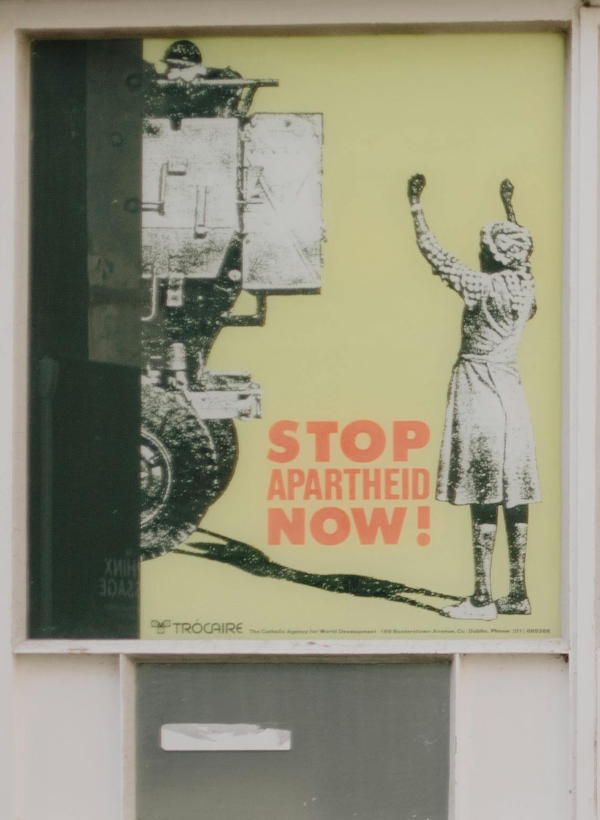 Photo: Sinitta Leunen
Direct advocacy and service
WWe also took on direct advocacy, developing press statements on core issues, and distributing short, punchy leaflets through unorthodox venues such as the bathrooms of (segregated) cinemas and restaurants (doing so to interrupt state propaganda and reach Whites who often could not see beyond their privilege). We used public graffiti too as a way of conveying our message; and regularly participated in marches and other protests.
Another prong of activities was engaging in direct service. This took on several forms and often was part of inter-organizational programmes. For example, we were active emotional supports to bereaved families at funerals, recognizing not only their grief but the potential trauma of mourning in the public eye.
The travelling from places of worship to burial sites was dangerous and subject to police scrutiny, and we attempted to offer some protection there. In another project, we were alongside when family members did the ritual cleaning of graves. Other programmes involved providing regular group support and counselling to family members who had loved ones in political detention or on death row, or whose relatives were missing or killed. To do so, we created extra-legal spaces, such as offering tea parties as a way of circumventing the limitation of meetings to three people; and held supportive discussions in minivans with relatives visiting family members on death row. We participated in the counselling roster at an interdisciplinary clinic set up for people released from prison and supported the development of crisis centres. To demonstrate that we were not simply about protest but also about service, we worked alongside other activists to build safe playgrounds and offered holiday camps in communities racked by violence. Another resource we developed and distributed widely were information and ‘self-help’ leaflets that offered how-tos and lists of useful organizations. (Clearly this was in a pre-internet and social media context!) We developed manuals for social service workers, such as working with children who had been exposed to familial, community and political violence, and ran groups with such children.
In indirect service, we made our skills available to emergent civic society organisations, assisting in capacity building in areas from managing an office (and how to do filing) to managing the organisation (including how to do funding applications).
We understood the risks of such participation and appreciated that some of our members had greater resources to deal with state harassment, arrest and harm than others. Where we could, we leveraged such resources to protect those more vulnerable. We though could not prevent state action against some members, but did attempt in solidarity to support our comrade-colleagues and their families during these times.
We were a reflexive group, constantly reviewing power dynamics within our group, facilitating what we understood to be democratic processes, considering how to expand inclusion, discussing how to activate all members, assessing advocacy tactics and strategies, and identifying novel social work learning. We thus had a comprehensive, detailed approach that was informed by progressive principles of community organizing. While the wide ambit we gave ourselves admittedly stressed our capacity, it was having several organizational pillars that also strengthened the work and ensured its impact.
How did our actions matter?
? Social workers in our region and indeed nationally could no longer claim to be ignorant of what structural and systemic harm was being conducted against children and families, and where they might be complicit in this. We offered social workers who wanted to act, venues where they could do so, commensurate with the risks they were able to take. We demonstrated how social workers could engage in social justice, and what alternative and home-grown/indigenous social work responses might entail. We expanded the knowledges, skills and competencies of social workers and those delivering various social services. We publicly (and internationally) problematized apartheid policies and actions, especially regarding children and families. We contributed to the generation of new knowledges, such as around the management of individual trauma or supporting communities during trauma; and shifted discourses, for example, around what constituted harm to children and families and why. Engagement in such progressive social work for many of the members shaped a long-term commitment to social justice. In detailing our efforts, I do not want to overstate the effect we had- especially as this work was located within partnerships. Outcomes thus reflect collective investments. I do though want to underline that a relatively small group of social workers could make a meaningful stand against injustice..
CSW did ultimately not continue as a professional association. Post the release of Nelson Mandela in 1990 and the associated transition towards democracy, the purpose of the organisation became less clear, especially as it was a city based rather than a national association. It’s members, particularly those at its core, were fatigued. Some had endured arrest, imprisonment and/or had been harassed by the social work regulating body. The work had been intense and exhausting. Social workers were directing their energies into intersectoral groups, advancing ideas for post-apartheid policy frameworks, from Developmental Social Welfare (spearheaded by Leila Patel) to youth justice to comprehensive health approaches. Regional and national welfare coalitions emerged that were more suited to engaging with anticipated post-apartheid structures and imperatives. However, CSW had made important contributions to shifting the South African welfare landscape and promoting socially just ways of engaging with children and families.
Social workers internationally do find themselves in contexts, not just of unfairness or lack of kindness, but of structural and systemic discrimination, repression and oppression. It is easy to become inducted into dominant ways of thinking that individualize problems and make children, families and communities responsible for the challenges they face. Social workers organising collectively and within broader alliances might find the courage and the support to resist harmful systems, act for good and promote fundamental social transformation.
The history of CSW is reflected also in the pieces referenced below. Yu and Mandell’s book provides several illustrations of extralegal work. I also want to point to Ioakimedes and Whllie’s edited volume from 2023, Social Work Histories of Complicity and Resistance that details further examples of social workers acting against injustice.
References
- Schmid, J. & Sacco, T. (2012). A story of resistance: Concerned Social Workers. Social Work Practitioner-Researcher, 24(3), 291–308.
- Sacco, T.M. & Schmid, J. (2015). Politicizing welfare and humanizing politics: Social workers opposing apartheid South Africa’s policies. In N. Yu & D. Mandell (Eds.), Subversive social action: Extralegal action for social justice (pp. 41–60). Waterloo, ON: Wilfrid Laurier University Press.
Author Affiliation
Research Fellow Centre for Social Development in Africa, University of Johannesburg, South Africa
Adjunct professor, Department of Social Work, Vancouver Island University, Canada