

Comments on the Eighth Report on Regional Progress and Challenges of the 2030 Agenda for Sustainable Cities and Communities: Considerations for post-Agenda community-territorial social work
What will happen to global public policies once the 2030 Sustainable Development Agenda expires? Will there be a new global agenda for urban development? Will social work be able to politically influence its definitions? And if so, from what epistemological position will it influence the new political orientations of the post-agenda? And even more so, how will the profession deal with the tension between social mobilization and resistance and the democratic system?
These legitimate questions arise from a prospective analysis of the role that Social Work will play globally in the decisions adopted by States in their role as drivers of development processes. Specifically, we are interested in addressing the impact of Social Work on land “access” and “use” policies, which are currently entirely dominated by the market system that reproduces profound territorial inequalities and social exclusion. This perspective will be based on citizen influence in these state policies or decisions.
One of the historical objectives of the discipline of Social Work has undoubtedly been the concern for strengthening territorially peripheral community organization or action. As Rasse et al. point out, in Latin American urbanization, the periphery has almost always been segregated and its inhabitants regularly stigmatized. From various disciplines, its occupants have been called miserable, poor, marginalized, informal, excluded, vulnerable, and again marginal (Rasse et al., 2021). In this context, Latin American states have historically integrated Social Work professionals into their public policies, from a role as operator of social housing and habitat policies, advisors on women's entrepreneurship programs, or generators of initiatives for productive development. However, this role is now being implemented under global considerations from a gender perspective and under the rationalizing principles of state modernization agendas, implemented from a “top-down” decision-making system, typically led by planning technocrats and subject to the determinants of a market system. For Oliver et al., the structural, systemic and endemic crisis of capital was further deepened by COVID-19 (Oliver et al., 2022), which undoubtedly increased social exclusion.
Although historically, Social Work has been interested in community issues primarily from the perspective of their organization and functionality to address the problems of industrial development and social exclusion, it has not, until today, highlighted the hegemonic importance of political issues regarding the use of territory, dominated by capitalist urbanisms based fundamentally on the theory of location (Coq, 2016), which recognized space as a key factor in the productive mechanism, relegating people to a secondary role. The concept of community has been a persistent element of debate in the theory and practice of social intervention. Basically, it could be stated that it is a space in which “common actions are carried out and where relationships of affection exist between people” (Vecina‑Merchante, 2024).
A new perspective forces us today to develop efficient and effective responses from ecological or ecosystem models that go beyond industrial‑capitalist rationality and that socially produce more equitable and inclusive territories, where issues such as “inward” decentralization (Castells, 1999) constitute the pillars of new development and where Social Work contributes what no other profession declares in its founding claims: seeking equitable access to development services and goods.
This paradigmatic shift challenges us to generate a critical perspective that includes better and greater citizen participation in all stages of territorial planning (Guardamagna & Reyes, 2019). It is necessary to strengthen the measurement system used for this purpose, where we should move towards more qualitative and intangible issues of development (Boisier, 1999). The goals incorporated in the 2030 Agenda, such as percentages of cities that use participatory planning, are insufficient. It is not enough to “count” cities that integrate planning instruments. There are a series of neighborhood and community dynamics in the territories that do not participate in these processes, becoming invisible for different reasons: political and ideological resistance from groups, deteriorated internal organizational processes, incapable local managers, lack of political will, questioned representation systems, lack of inter‑institutional trust, weak symbolic capital, among others.
The new development models advanced by global actors since the so‑far “failed” 2030 Agenda invite us to foster the long‑awaited territorial governance that entails increased dialogue between actors and consensus‑building. We know this is incipient, although States have proposed it as a cornerstone of their modernization agendas. The Latin American Center for Development, for example, considers public management to be sound if it satisfactorily meets pre‑established parameters of integrity, efficiency, efficacy, effectiveness, equality, and equity, referenced to a positive impact on social development and people's quality of life. To this end, it must be essentially democratic, ensuring the achievement of levels of quality and excellence in its performance and results (CLAD, 2009).
At the recent Forum held in Santiago, Chile in April 2025, the chapter entitled "Participation of other governmental and non-governmental actors in accelerating and monitoring progress towards achieving the Sustainable Development Goals" noted that achieving the Sustainable Development Goals (SDGs) requires the active and coordinated participation of multiple actors. “In Latin America and the Caribbean, civil society, the private sector, academic institutions, local governments, and the legislative branch have contributed to monitoring and achieving the SDGs” (ECLAC, 2025, p. 145). It is stated that civil society organizations have been key in defending human rights, evaluating public policies, and promoting social innovation.
As noted, the scenario for achieving the Agenda's objectives is complex, given the level of acceleration.
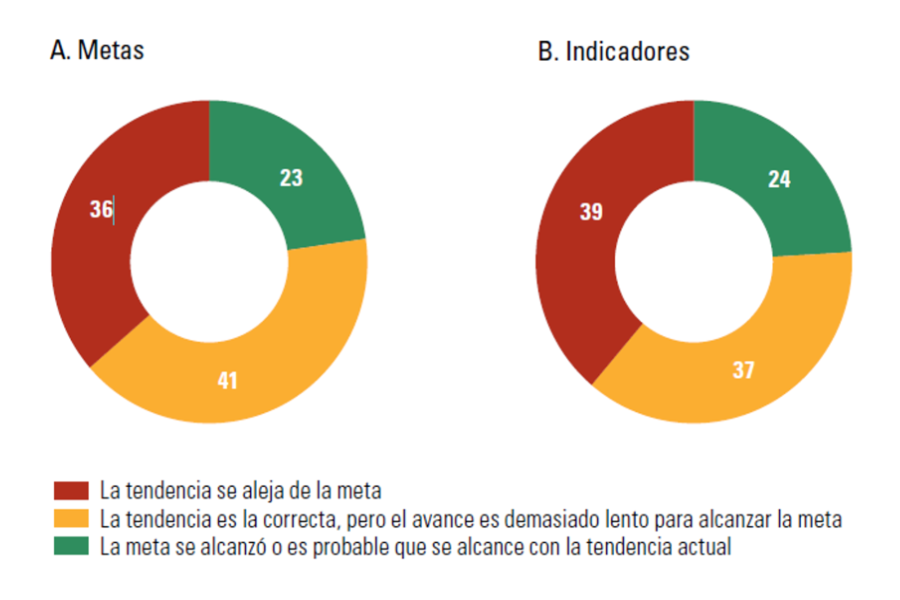
Figure 1. Latin America and the Caribbean: SDG targets and indicators according to the likelihood of their being met by 2030 and 2025. Source: ECLAC, 2025.
Regarding the progress of the Agenda, there is currently an intermediate position of indicators in a situation of regression or stagnation (observed in SDG 5, SDG 7, SDG 8, SDG 11 and SDG 14) and more than 50% of the indicators of SDG 5, SDG 8 and SDG 16 are going in the right direction, but at an insufficient pace to achieve the fulfillment of the goals. The objectives with 20% or less of indicators with auspicious forecasts include SDG 1, SDG 2, SDG 4, SDG 5, SDG 6, SDG 10, SDG 13 and SDG 16. Regarding the status of SDG 11 “Sustainable cities and communities”, of the four targets proposed, only one indicates that it has been achieved or is likely to be achieved with the current trend, two of them indicate that the trend is correct, but progress is too slow to reach the target and one that the trend is moving away from the target (ECLAC, 2025, p. 41).
According to ECLAC, between 1980 and 1990, civil society organizations in the region emerged as crucial actors in democratic transitions and have consolidated their position primarily in three key areas: the promotion of human rights and social inclusion; the monitoring and evaluation of the SDGs by preparing alternative reports that complement government reports; and innovation and technology, with the understanding that the adoption of digital tools has strengthened the operational and forward-looking capacities of civil society organizations. To address these challenges, Chile, for example, has promoted consensus and collaborative actions toward sustainability. A milestone of this renewed commitment has been the adoption of the National Strategy for the Implementation of the 2030 Agenda (Government of Chile, 2023).
In short, we believe that Social Work should leverage its experience and historical mastery in community organizing, apply its historical know‑how in new dimensions such as climate change, gender diversity, the territorial approach and decentralization, social integration, digital methodologies for citizen participation, among others. At the same time, a new methodological framework must be developed from public policies that incorporate new goals and indicators that better demonstrate community dynamics as part of a democratic system and never antagonistic to the role of the State. This discussion will be central to Social Work, which must resolve how social resistance is articulated within a democratic and representative framework. As the prominent communitarian Marco Marchioni pointed out: “Things have gotten much worse because everything that seemed communitarian seemed like an alternative to the democratic system, and this is an issue that has always concerned me greatly. It is born and develops in a situation where working with people means organizing them to change what exists, clearly. There aren't many other possibilities. This positive message must be transplanted into a democratic system where change is possible. Not in a violent way, but as an evolution of a democratic system” (Oliver et al., 2022).
Bibliographic References
- Boisier, S. (1999). Territorial Development through Synergistic Capital Construction. Brazilian Journal of Urban and Regional Studies, No. 2, Nov 1999, 39–53
- Castells, M. (1999) Globalization, Identity and State in Latin America. UNDP
- CLAD (2009) Ibero-American Charter of Citizen Participation in Public Management.
- Economic Commission for Latin America and the Caribbean (ECLAC), Latin America and the Caribbean and the 2030 Agenda, Five Years from the Goal: How to Manage Transformations to Accelerate Progress? (LC/FDS.8/3), Santiago, 2025
- Coq, D. (2016) The Neoclassical Theory of Localization: Some Bases for its Criticism. Lider Magazine 18(29), 9–31
- Government of Chile (2023) Voluntary National Report on the Sustainable Development Goals in Chile. National Council for the Implementation of the 2030 Agenda for Sustainable Development (SDG). Santiago, Chile.
- Guardamagna, M. & Reyes, M. (2019) The challenge of implementing participatory public policies for territorial development. Journal of Economy, Society and Territory, 18(59), 1003–1033
- Oliver, M.A., Carrara, V.A., & Matos‑Silveira, R. (2022). Community Development, Citizen Participation, and the Political Dimension of Social Work. Trabajo Social Global – Global Social Work, 12, e23687, 1–18. https://dx.doi.org/10.30827/tsg-gsw.v12.23687
- Orozco, H. (2021) Towards a new digital pact in urban planning: Contributions and challenges of digitalization in the participatory design processes of cities in Chile and Colombia. Carolina Analysis No. 36. Carolina Foundation
- Rasse Figueroa, A., Robles, M.S., Sabatini Downey, F., Cáceres Quiero, G., & Trebilcock, M.P. (2021). From segregation to residential exclusion… Revista de Urbanismo (44), 39–59. https://doi.org/10.5354/0717-5051.2021.55948
- Vecina‑Merchante, C. (2024). Marco Marchioni and community action: A systematic description of his main ideas. EHQUIDAD (22), 83–112. https://doi.org/10.15257/ehquidad.2024.0014