


Beyond Philanthropy: Social Work's Crucial Role in Authentic ESG and a Path Towards Emancipatory Change
The Environmental, Social, and Governance (ESG) framework has emerged as a paramount lens for evaluating corporate performance, fundamentally shifting the paradigm of corporate responsibility beyond mere profit maximization (Annesi et al., 2024). While environmental and governance aspects often capture headlines, the 'Social' pillar, or the 'S' in ESG, represents a complex domain encompassing a company's relationship with its entire human ecosystem—employees, suppliers, customers, and communities.
This domain is critically concerned with human rights, equity, and the ethical treatment of all individuals impacted by business activities. As corporations increasingly acknowledge the link between robust social performance and financial value, the demand for genuine expertise in navigating complex social systems has become a core business imperative. This article posits that for social work, strategic engagement in ESG is not merely an opportunity but a political imperative (Chu et al., 2009) —a necessary battleground for advancing its ideals of justice and human rights, as illustrated by the compelling case of the CFSC x HKSYU ESG Symposium in Hong Kong.
The Strategic Fit: Why Social Work is Essential to the 'S' in ESG
The 'S' pillar of ESG is a comprehensive framework covering human capital, product liability, community engagement, and supply chain responsibility. Managing these requires a dynamic understanding of social systems, not a static checklist. However, the 'S' pillar faces a significant challenge: the difficulty of measurement. Unlike standardized financial metrics, social metrics are nuanced, creating fertile ground for ‘social washing’ (Todaro & Torelli, 2024) —a disconnect between stated commitments and tangible actions that can lead to severe reputational and financial damage. Avoiding this demands authenticity and rigor, moving beyond outputs to measure genuine outcomes.
Herein lies social work's strategic advantage. The profession’s code of ethics and training in community work or macro practice could serve as a powerful antidote to social washing. Three competencies are particularly vital:
- Systems Theories (cf. Healy, 2022): Social work employs a holistic lens to understand corporations as complex systems interacting with their environments. This allows practitioners to identify root causes of problems (e.g., high employee turnover as a symptom of systemic issues in compensation, management, or community factors) rather than merely treating symptoms, leading to more sustainable solutions.
- Stakeholder Engagement: In the tradition of community work (e.g., Kanjilal & Arnull, 2025), social work trains practitioners to engage diverse stakeholders, facilitate difficult conversations, and build consensus. This is essential for an authentic ESG strategy that relies on genuine dialogue with employees, communities, and customers, not top-down directives.
- Advocacy: Value-bounded to advocate for social justice (IASSW & IFSW, 2018), social workers in a corporate context can serve as a vital check on power. They can push for initiatives that create genuine community empowerment and systemic change, countering the political pressure for superficial public relations and ensuring that corporate actions align with stated values.
Emerging regulatory requirements like ‘double materiality,’ which mandate reporting on a company's impacts on people and the environment (Nielsen, 2023), align perfectly with social work’s foundational ‘person-in-environment’ perspective, uniquely positioning the profession to lead this complex aspect of modern ESG strategy.
Navigating the Political Landscape: Barriers to Engagement
Despite this clear synergy, a significant chasm persists between social work and strategic ESG. Related studies (Terblanche et al., 2021) illustrates that profession’s historical relationship with business has been ambivalent and reactive, focused on mitigating negative social externalities through programs like Employee Assistance Programmes (EAPs). This has ‘typecast’ social work in a supportive, rather than strategic, function. Deeper ideological divides further complicate engagement. The mission of social work is intrinsically linked to challenging systems that perpetuate inequality, often viewing capitalism critically. This professional commitment creates a paradox: deep engagement with the corporate sector can be perceived as ‘co-optation’ or a betrayal of the profession's mission. This internal political paralysis, born from a valid fear of co-optation, ultimately prevents the profession from seizing strategic ground and challenging corporate power where it is most influential.
The divides above are compounded by mutual misunderstanding. Business leaders often narrowly associate social work with welfare or therapy, failing to recognize macro-level expertise (Lee, 2016). Conversely, based on the authors’ observations and the literature (Long, 2018), social work leaders perceived potential threats working with private sector. All these stereotypes prevent them from seeing opportunities for change. This creates a ‘translation problem,’ where a social worker might identify a community need but lack the business vocabulary to frame it as a material risk or value-creation opportunity. This is not merely a communication gap; it is a political challenge. Learning to wield the language of power—of finance, risk, and strategy—is a political act necessary to advocate for social work's values in a new arena. Related development therefore seems to be hindered by structural deficits in social work education and professional bodies, which have yet to fully embrace corporate ESG as a legitimate macro-practice area, leaving interested social workers without clear pathways or validation.
The Hong Kong Context: A Case for Co-Creation
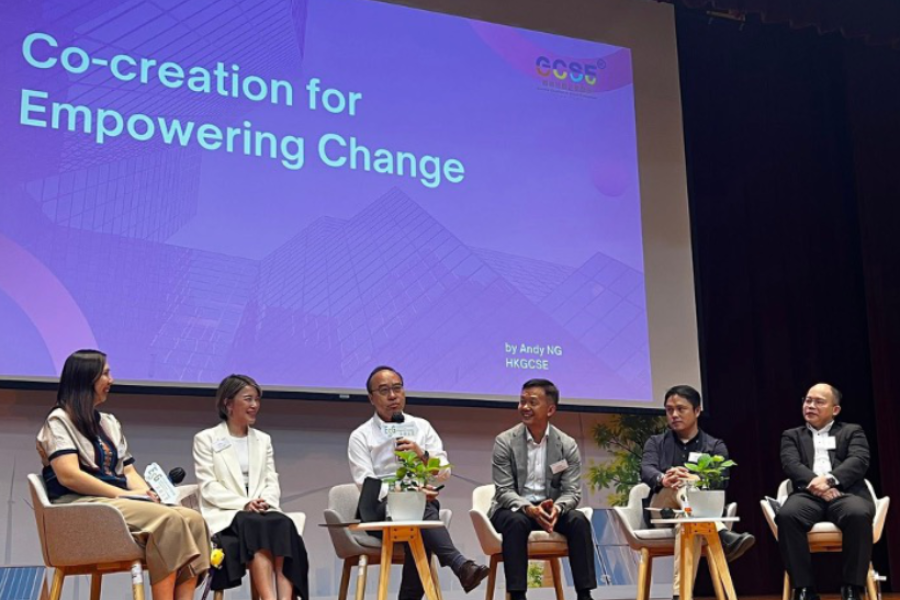
The ‘Co-creating the Future: ESG and Social Impact Symposium,’ (CFSC Green, 2025) hosted by the Christian Family Service Centre (CFSC) and Hong Kong Shue Yan University (HKSYU), serves as a compelling case illustration of the drive to bridge this gap. The symposium tried to build a more sophisticated understanding in Hong Kong context that social work and NGOs are not merely recipients of corporate philanthropy but essential, strategic partners. The discussions revealed two critical themes for navigating the politics of this engagement:
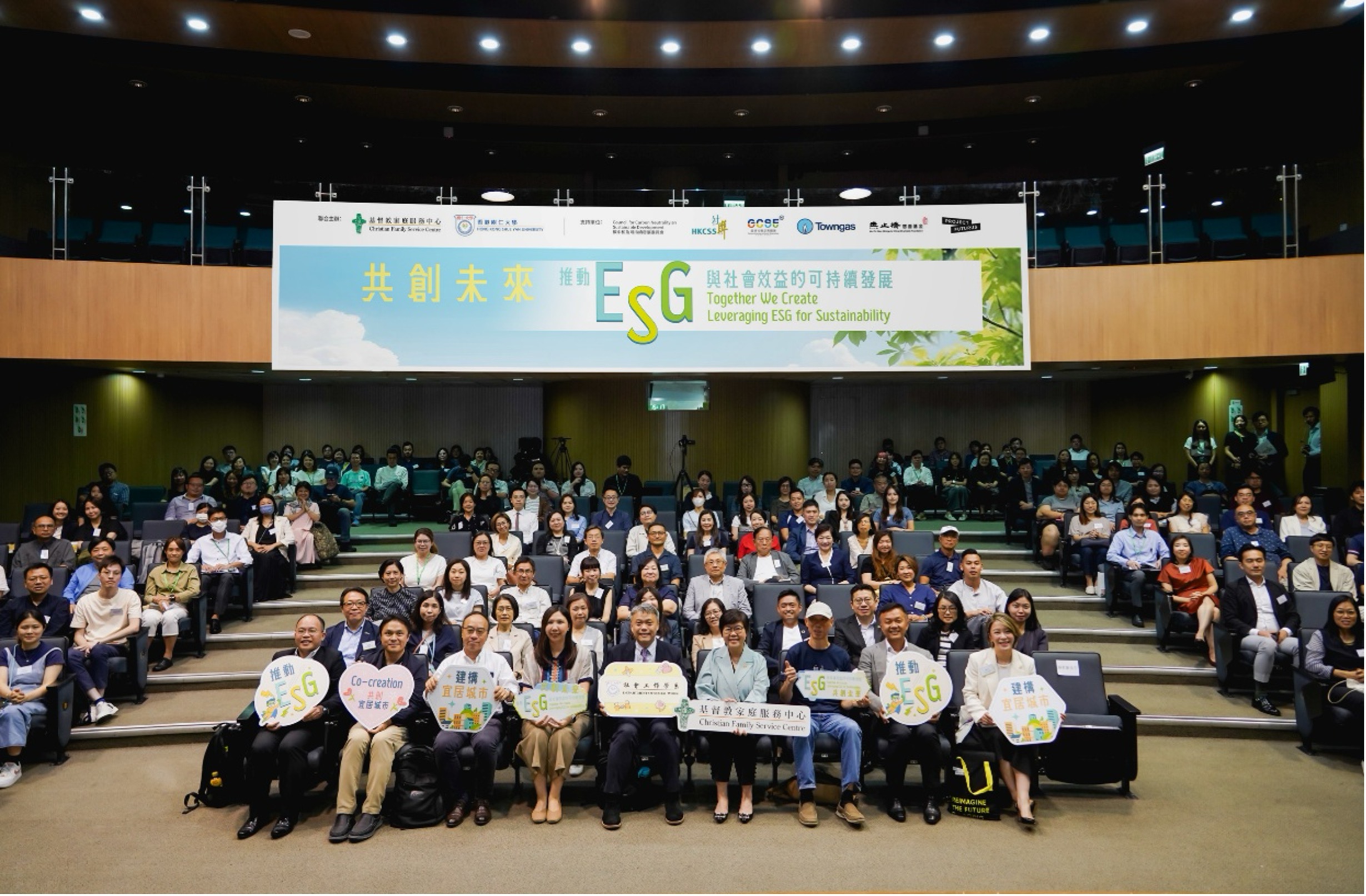
Group photo of the symposium
First, a prominent theme was the urgent call to transition from a passive ‘charity model’ to a proactive framework of ‘co-creation.’ Business representatives articulated a clear shift away from simple sponsorship towards impact-driven partnerships. A leader from the social enterprise sector challenged that to be convincing, the social sector must supplement its compelling ‘stories’ with quantifiable ‘figures.’ This point was illustrated by a social entrepreneur who demonstrated how turning a social need—specialized diets for those with swallowing difficulties—into a viable business model required designing programs from a ‘consultant's angle,’ fully integrated with corporate KPIs. This strategic repositioning is inherently political, demanding that social work moves from being a supplicant for funds to an equal partner offering measurable value.
A second critical theme addressed the ‘political push and pull’ of ESG implementation. A government advisor framed Hong Kong's carbon neutrality goal not as a mere ‘political slogan’ but as an ‘actionable’ target, urging the social sector to leverage its scale and ‘overtake’ society's progress. This perspective casts ESG as a proactive political project rather than a passive compliance exercise. Echoing this, an academic leader in social work argued that while the profession may be a novice in the ESG space, its foundational focus on ‘people’ and justice provides a unique opportunity to lead on the 'S' pillar, where businesses often struggle. This vision rejects a subordinate role, advocating instead for an ‘equal partnership’ where social work's deep understanding of community needs and government policy becomes a key asset in facilitating impactful collaborations.
Towards an Emancipatory Social Work in ESG
For social work to remain relevant to its ideals of justice, human rights, and a courageous commitment to emancipatory change, strategic engagement in ESG is a necessary evolution. The historical tendency to operate reactively or to view engagement with capitalism as co-optation limits the profession's ability to influence systemic change (cf. Cheung, 2025). By strategically embedding itself within corporate frameworks, social work can move from the periphery to the core of power, seizing a crucial opportunity to challenge and reshape corporate behaviour from within to advance its mission of social justice.
This is a political project for the profession. It requires adapting our language and approach, communicating value not just through ‘stories’ of individual impact but also through the ‘figures’ of SROI and other methodologies that resonate with the business imperative of ‘earning, survival, and growth.’ This is not about abandoning our values but about finding a more powerful way to enact them.
Bridging this chasm requires more than dialogue; it demands a concerted, profession-wide political strategy. Corporate leaders should recruit social workers for strategic ESG roles. The social work profession, through bodies like IASSW and IFSW, should reform educational standards to recognize corporate ESG as a legitimate macro-practice area and create specialized credentials. Academic institutions should foster transdisciplinary research and specialized postgraduate program to cultivate a new generation of leaders fluent in both social justice and corporate strategy.
By embracing these pathways, social work can transcend its traditional roles and become an essential player formulating corporate strategy, ensuring ESG initiatives are authentic, impactful, and rooted in justice. This forging of a new paradigm, where corporate success and social progress are fundamentally intertwined, is the courageous next step towards a more equitable and sustainable future.
References
- Annesi, N., Battaglia, M., Ceglia, I., & Mercuri, F. (2025). Navigating paradoxes: Building a sustainable strategy for an integrated ESG corporate governance. Management Decision, 63(2), 531–559. https://doi.org/10.1108/MD-10-2023-2006
- CFSC Green. (2025, June 9). Official Live Broadcast. Hosted by Christian Family Service Centre x Hong Kong Shue Yan University, ‘Together We Create: Symposium on Leveraging ESG for Sustainability.’ [In Chinese] https://www.youtube.com/watch?v=pzvnPKItq0E
- Cheung, J. C. S. (2025). Refocusing social work education on community work in Hong Kong: an urgent call. Community Development Journal, 60(1), 33–40. https://doi.org/10.1093/cdj/bsae052
- Chu, W. C. K., Tsui, M., & Yan, M. (2009). Social work as a moral and political practice. International Social Work, 52(3), 287–298. https://doi.org/10.1177/0020872808102064
- Healy, K. (2022). Social work theories in context: Creating frameworks for practice (3rd ed.). Bloomsbury Publishing.
- IASSW & IFSW. (2018). Global social work statement of ethical principles. International Association of Schools of Social Work; International Federation of Social Workers. https://www.iassw-aiets.org/global-social-work-statement-of-ethical-principles-iassw
- Kanjilal, M., & Arnull, E. (2025). Co-producing social work knowledge: collaborative approaches between communities, practitioners and social work educators. Social Work Education. https://doi.org/10.1080/02615479.2025.2462554
- Lee, W. (2016). Social Work-Business Sector Collaboration in Pursuit of Economic Justice. Social Work, 61(3), 209–216. https://doi.org/10.1093/SW/SWW019
- Long, A. (2018). Social Work Grand Challenges: Leaders' Perceptions of the Potential for Partnering with Business. Social Work, 63(3), 201–209. https://doi.org/10.1093/sw/swy015
- Nielsen, C. (2023). ESG Reporting and Metrics: From Double Materiality to Key Performance Indicators. Sustainability, 15(24), 16844. https://doi.org/10.3390/su152416844
- Terblanche, L., Gunya, T., Pretorius, M., Maruma, M., Mbuyisa, K., Maseko, T., Mojapelo, K., Myeni, N., & Tyson, W. (2021). Employee assistance programmes and occupational social work: Interrelated with distinct features. Social Work/Maatskaplike Werk, 57(2), 16–38. https://doi.org/10.15270/57-1-904
- Todaro, D. L., & Torelli, R. (2024). From greenwashing to ESG‑washing: A focus on the circular economy field. Corporate Social Responsibility and Environmental Management, 31(5), 4034–4046. https://doi.org/10.1002/csr.2786