

Social Work at a Crossroads: Legislative Reforms, Civil Protest, and Professional Challenges in Georgia
Introduction
After the dissolution of the Soviet Union in 1991, Georgia gained independence, marking a transitional period in the country's history. Following independence, Georgia entered an entirely new phase of development, laying the foundation for democracy. However, the 1990s proved to be a particularly difficult time for the Georgian population. During this period, various services began to emerge, and efforts were made to secure international grants (Sadzaglishvili, 2017).
It is important to note that social work in Georgia is closely linked to legislative changes concerning the adoption of orphans and children deprived of parental care. The relevant law was enacted in 2000, and its implementation required the involvement of social workers. Social workers became engaged in the deinstitutionalization process, with their responsibilities including the assessment of families (Sadzaglishvili, 2017).
In Georgia, social work is a regulated profession governed by the “Law on Social Work,” adopted in 2018 (Ministry of Justice of Georgia, 2018). This law defines and standardizes the functions and responsibilities of social workers, emphasizing their obligation to protect the best interests of beneficiaries. The “Law on Social Work” applies to social workers employed in the public sector, as well as those working in non-governmental organizations and private institutions. Among the key duties outlined in the law is the responsibility of social workers to maintain confidentiality. They are prohibited from disclosing any information about a beneficiary without their informed agreement and consent. This obligation remains binding even while the social worker is actively engaged in professional duties. Social workers in Georgia operate across various fields, all of which are regulated by legislation. The Georgian Association of Social Workers has developed a Code of Ethics for the profession, which outlines the core values and principles that social workers are required to uphold (Sadzaglishvili & Shekriladze, 2020).
In 2019, the Code on the Rights of the Child was adopted (UNICEF Georgia, 2020). Following its enactment, the duties of social workers in the area of child rights protection became even more clearly specified. Social workers are now legally obligated to prioritize and safeguard the best interests of the child in all aspects of their professional practice (Sadzaglishvili & Shekriladze, 2020).
The Law on the Elimination of All Forms of Discrimination was adopted in Georgia in 2014, despite significant opposition from the conservative parties, primarily because the law also addressed the rights of sexual minorities. Nonetheless, the law was ultimately approved by Parliament. It should be noted that the adoption of this legislation was an important step by the Georgian government toward integration with the European Union (Civil Georgia, 2014).
...political developments and legislative changes in Georgia have had a direct impact on both social workers and the profession of social work itself.
Given the nature and purpose of the social work profession, it is inherently intertwined with significant developments taking place in society. Accordingly, political developments and legislative changes in Georgia have had a direct impact on both social workers and the profession of social work itself.
Since 2024, the social and political situation in Georgia has become increasingly tense, particularly following the adoption by the Georgian Parliament of three controversial laws: the “Law on Transparency of Foreign Influence”, “Georgian FARA” and the “Law on the Protection of Family Values and Minors.” The content of these laws provoked widespread public dissatisfaction, resulting in large-scale protests. Civil society and non-governmental organizations (NGOs) were actively involved in these demonstrations.
The “Law on Transparency of Foreign Influence” (2024, June 3) obliges NGOs to register as “agents of foreign influence.” In cases of refusal to register, organizations are subject to financial penalties. The adoption of this law has direct implications for the quality and accessibility of social services. Consequently, social workers actively joined the protests, as many are employed within NGOs and work with various vulnerable groups.
In addition, the “foreign agents law” or “Georgian FARA - (Foreign Agents Registration Act) officially entered into force on May 31, 2025. Adopted by the Georgian Parliament in April 2025, the law requires non-governmental organizations, media outlets, and other entities receiving more than 20% of their funding from abroad to register as “agents of foreign influence.” These entities must submit detailed financial reports and disclose their foreign funding within 10 days or face penalties—including fines or up to five years in prison. The law is enforced by the Anti-Corruption Bureau. While the government claims the measure promotes transparency, domestic civil society actors and international observers have widely criticized it as a tool to stigmatize independent voices and suppress dissent, drawing parallels to similar laws in Russia that restrict freedom of association and expression (OSCE, 2025)
In 2024, the Georgian Parliament also passed the “Law on the Protection of Family Values and Minors,” which aims to “protect family values based on the union of a man and a woman and to strengthen mechanisms for the protection of minors.” Of particular concern is Article 8 of the law, which addresses issues related to education. Its adoption sparked significant discontent among university professors, who raised questions about how to teach literary works by various authors and how to discuss global masterpieces without addressing topics related to gender and sexuality. In addition, the law is also seen as problematic for social workers, who provide services to members of sexual minority communities (Legislative Herald of Georgia, 2024).
The laws adopted by the Parliament of Georgia have brought significant changes not only to the non-governmental sector but also to the public sector. According to a statement by the “Union of Social Workers,” on December 25, 2024, social workers were dismissed from the Crime Prevention, Non-Custodial Sentences, and Probation National Agency (a legal entity of public law) due to their political views.
In addition, in Kutaisi, the only social worker and psychologist at the Juvenile Referral Center were dismissed. The “Union of Social Workers” filed a legal complaint, demanding the reinstatement of the dismissed social workers. Furthermore, on December 27, social workers held a protest in front of the National Probation Agency. Their primary demand was for agency leadership to meet with those social workers whose contracts would not be renewed as of January 1 (Publika, 2024).
The Georgian Association of Social Workers (GASW) has taken a firm stance in defense of democratic principles and professional ethics amidst the ongoing political unrest. In a public statement issued on December 10, 2024, GASW condemned the use of violence and unlawful arrests by government forces against peaceful demonstrators, arguing that such actions not only erode trust in public institutions but also violate the foundational values of the social work profession—human rights, social justice, and dignity. The Association further highlighted the dangers of undermining Georgia’s constitutional commitment to European integration, particularly in light of the decades-long support provided by the EU and the United States in building the country’s social protection and healthcare systems. GASW’s call for international solidarity underscores the role of social workers not just as service providers, but as vocal defenders of democracy and the rights of vulnerable groups (GASW, 2024).
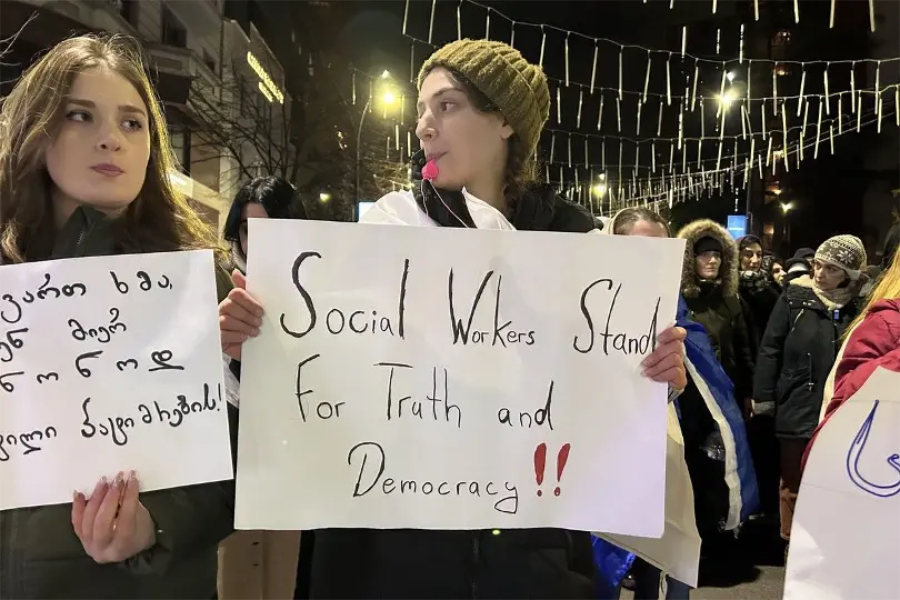
In fact, the adoption of the above-mentioned laws and the subsequent related changes have had a significant impact on the field of social work, leading to active engagement by social workers in civil protest. Social workers organized a Social Workers’ March, which unequivocally condemned the decisions made by Parliament. One of their demands during the demonstrations was the release of detained protesters.
While the recent laws adopted by the Georgian Parliament have generated significant domestic and international criticism, it is important to understand them within the context of national sovereignty, political stability, and cultural values. From the government's perspective, the Law on Transparency of Foreign Influence aims to increase accountability and transparency in a landscape where a substantial portion of social services and policy advocacy is funded by international actors. The government has argued that similar legislation exists in other democratic countries and that it does not prohibit NGO activity but seeks to clarify foreign involvement. Likewise, the Law on the Protection of Family Values and Minors presented by policymakers as a response to widespread public support for preserving traditional cultural norms and protecting children from what is perceived as premature exposure to contested social topics. For many supporters, these laws are seen as a way to preserve national identity and social cohesion in the context of globalization and ideological polarization, rather than as a rejection of human rights or democratic principles. Therefore, while the impact on civil society is considerable, the government’s actions can also be viewed as part of a broader struggle to navigate competing domestic and international pressures.
In politically charged and socially polarized environments—such as the current context in Georgia—social workers have a critical role to play in upholding human rights, advocating for marginalized groups, and maintaining professional integrity, even in the face of restrictive legislation. The international literature on social work under authoritarian or shrinking civic spaces emphasizes the profession’s dual role: providing direct services and engaging in advocacy for systemic change (IFSW, 2014; Dominelli, 2010).
According to the Global Definition of Social Work by the International Federation of Social Workers (IFSW), social work is “a practice-based profession and an academic discipline that promotes social change and development, social cohesion, and the empowerment and liberation of people.” This definition inherently positions social workers as agents of change who must address structural inequalities, particularly when government policies threaten the rights and welfare of vulnerable populations (IFSW, 2014). Lena Dominelli (2010) emphasizes that social workers must go beyond service delivery to act as "critical practitioners," capable of engaging with and challenging oppressive policies through advocacy, public education, and solidarity with social movements. In contexts where minority rights or NGO functions are being constrained—as in Georgia’s 2024–2025 political climate—this implies that social workers have a responsibility to participate in civic resistance, educate the public about rights violations, and support affected individuals and communities.
Additionally, Banks et al. (2020) argue that ethical social work practice in politically restrictive contexts requires a careful balancing act: maintaining neutrality in service provision while simultaneously advocating for justice. They emphasize that social workers should engage in “ethically grounded activism,” informed by core principles such as dignity, non-discrimination, and social justice—particularly when public policies contradict these values.
Given that social workers in Georgia are legally obligated to protect the best interests of children and uphold confidentiality and non-discrimination (Law on Social Work, 2018; Code on the Rights of the Child, 2019), their role also includes speaking out when new laws may hinder their ability to fulfill these duties. They are thus positioned not only as service providers but also as watchdogs against the erosion of professional ethics and client rights.