
Responsibility and Grievability in Preserving Minority Histories: Toward Transformation of Depoliticized Social Work in Japan
Introduction
Social work has always been inherently political, even when it seeks to adopt a neutral stance. In Japan, however, mainstream social work has often maintained a conservative, technocratic, and ostensibly “depoliticized” posture, avoiding contentious historical and political issues. This reluctance has contributed to the marginalization of minority histories, leaving Japanese society ill-equipped to address collective trauma and structural inequities.
This article examines a grassroots citizens’ movement in Gunma Prefecture, Japan, which sought to preserve the history of Koreans who were victims of forced labor under Japanese colonial rule through the construction of a memorial monument.
Since early 2024, I have been engaged in fieldwork, conducting research and collaborating with artists and Zainichi Korean community members. Drawing upon Iris Marion Young’s Social Connection Model of Responsibility and Judith Butler’s notion of Grievability, the discussion situates the struggle over the Gunma monument within broader debates on historical injustice, memory politics, and the political responsibilities of social workers.
The central argument is that preserving the history of oppressed minorities is not merely a symbolic gesture, but an essential component of politically engaged social work. By embracing responsibility for historical injustice and defending the grievability of marginalized lives, social workers can challenge the structural conditions that perpetuate oppression and transform the conservative traditions of Japanese social work.
Historical Injustice and the Politics of Memory in Japan
The history of Zainichi Koreans (Korean residents in Japan) is inseparable from Japan’s colonization of Korea (1910–1945). More than one million Koreans were brought to Japan, many under coercion, to work in mines, factories, and construction sites under harsh and dangerous conditions. After Japan’s defeat in 1945, structural discrimination persisted: Zainichi Koreans faced barriers to citizenship, education, and employment.
Efforts to preserve the memory of colonial victims and mourn those who died unjustly have been sustained by determined descendants and local Japanese activists. In some regions, these efforts led to the erection of memorial monuments and commemorative ceremonies. At the same time, such acts of remembrance have often been violently disrupted by historical revisionist and xenophobic groups. Local governments, pressured by these forces, have sometimes failed to protect commemorative practices and even engaged in human rights violations by ordering the removal of memorials and restricting mourning. Thus, the politics of memory and mourning in Japan is deeply intertwined with struggles over historical responsibility, state accountability, and minority rights.
Case Study – The Memorial Monument in Gunma Prefecture
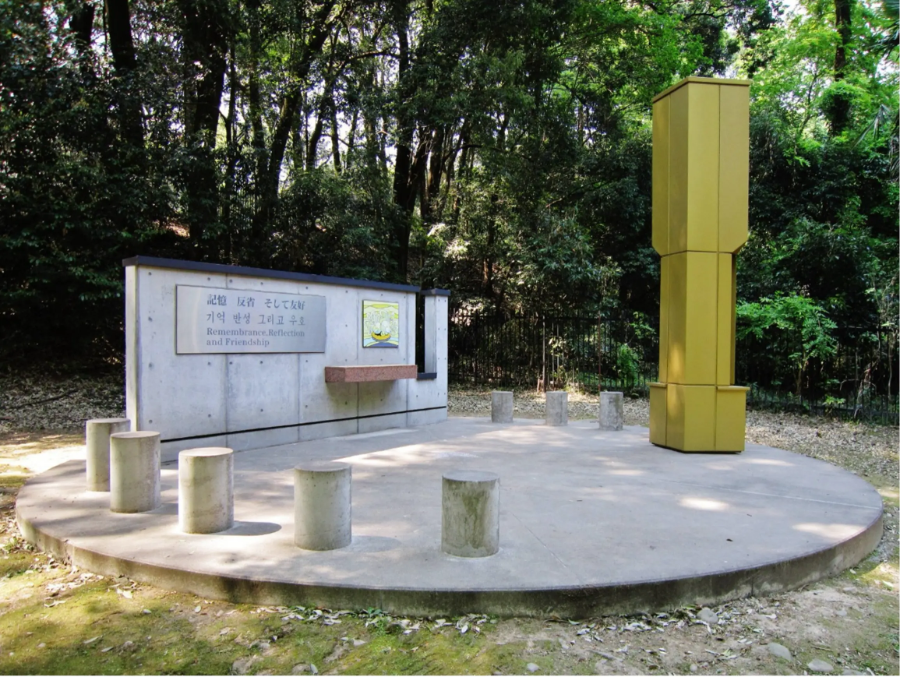
Establishment of the Memorial Monument
Gunma Prefecture, in inland eastern Japan, was a site where many Koreans were forced to work in munitions factories and mines during the war, and many lost their lives. Despite being a region with strong conservative political forces, some local residents made determined efforts to preserve the memory of colonial victims and mourn those who perished.
In 1991, amid nationwide momentum to investigate forced mobilization of Koreans, the “Gunma Prefecture Fact-Finding Committee on Forced Mobilization” was established. Building on this, in 1995 the “Gunma Citizens’ Action Committee to Question Fifty Years After the War (Action 50)” was formed. Action 50 conducted investigations, organized exhibitions, published pamphlets, and deepened exchanges with peace-oriented civic groups in Korea. In 1998, recognizing the absence of a memorial, the “Association to Erect a Memorial for the Victims of Forced Mobilization of Koreans” was formed, initiating a full-fledged campaign to build the monument. In June 2001, a petition for land provision was unanimously adopted by the Gunma Prefectural Assembly, leading to the construction of the memorial in Gunma no Mori (Forest of Gunma).
The memorial was completed, and its unveiling ceremony was held on April 24, 2004. A pamphlet issued after its completion included photographs from the unveiling: local politicians giving speeches in front of the memorial, students from Korean schools singing in chorus, and bereaved families of victims who had come from South Korea. These images conveyed that the establishment of the memorial was warmly welcomed by many people.
The pamphlet also set forth two reasons for the memorial: first, to mourn those who were forcibly separated from their homeland and who perished while longing for home; second, to express, as Japanese individuals, a frank reflection on the wrongs committed by Japan in the past and to affirm a vow never to allow such a thing to happen again. It concluded by linking the movement to broader aims of democracy, human rights, friendship with Asian peoples, and peace, pledging to continue the work even after the memorial was erected.
Destruction and Removal
Local initiatives continued under the renamed group, “Association to Protect the Memorial Monument of ‘Memory, Reflection, and Friendship,’” holding commemorative gatherings. However, in 2014, Gunma Prefecture denied renewal of the ten‑year installation permit, judging statements such as “reveal the reality of forced mobilization” as political activity. This decision followed petitions by xenophobic groups and conflicts during protest actions, reflecting strengthened reactionary forces.
The group sued to overturn the non‑renewal decision. In 2018, the Maebashi District Court ruled the prefecture’s action illegal as an abuse of administrative discretion. Gunma Prefecture appealed, and the Tokyo High Court overturned the ruling. In 2022, the Supreme Court upheld the High Court’s decision.
On January 29, 2024, Gunma Prefecture carried out administrative removal, shattering and destroying the monument, despite strong citizen opposition. Governor Yamamoto Ichita remarked that the monument’s existence had itself become controversial. Denialist narratives emboldened xenophobic groups and influenced administrative decisions.
Impact of the Monument’s Removal
At a memorial ceremony, a Zainichi Korean speaker said: “With the establishment of the monument, we were finally able to mourn our ancestors. Even as hate speech worsened nationwide, I thought that because Gunma has this memorial, it represents the conscience of Japanese society.”
The primary significance of the memorial lay in enabling commemoration of those who had perished—acknowledging those forcibly mobilized and creating a space for mourning. Its removal denied the history of colonialism, forced mobilization, and labor exploitation, fostering discrimination and local divisions. Reports of mental‑health deterioration among some Zainichi Koreans following the removal illustrate the enduring impact of historical trauma.
The monument also served educational and public functions. Schools held activities at the site, teaching children about war and colonial history. Local residents used it for engagement and dialogue, making it a key site for historical education and coexistence. Its removal erased victims’ memory, collective mourning, and educational significance.
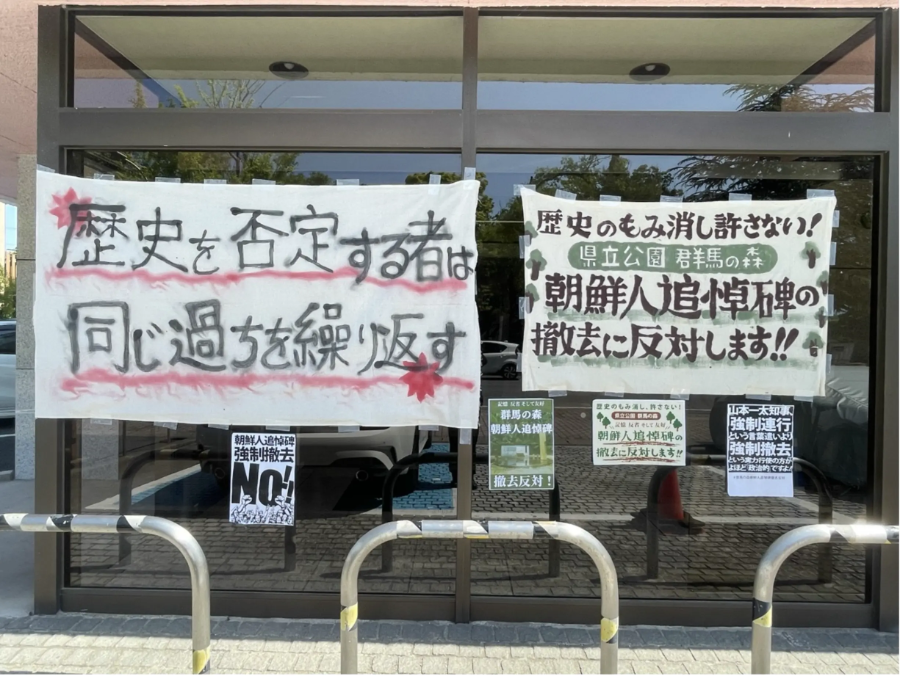 Photo: Osamu Miyazaki
Discussion
Young’s Social Connection Model of Responsibility provides a powerful lens for understanding why the preservation of minority histories must be regarded as a collective, non‑discretionary obligation. The model asserts that all individuals and institutions connected to structural injustice share a forward‑looking responsibility to work toward its elimination, regardless of personal guilt.
In the Japanese context, the oppression of Zainichi Koreans during the colonial era should be seen as part of ongoing structural inequalities that persist today—precarious residency conditions, discretionary access to certain social welfare programs, exclusion from tuition‑free education schemes, and enduring social stigma—all rooted in colonial legacies.
The Gunma memorial exemplified responsible action: a visible commitment to remembering victims and resisting erasure. Its removal violated that shared responsibility. As professionals embedded within social structures, social workers have the capacity and obligation to oppose such breaches.
Butler’s concept of grievability further illuminates the impact of the removal: whose lives are recognized as publicly mournable? The monument enabled public acknowledgment that Korean victims of forced labor are lives worth grieving—challenging dominant historical narratives. Removing it reasserted a hierarchy of grief in which colonial victims are marginalized.
From a social‑work perspective, defending grievability is not simply empathy; it is resistance to the institutionalized devaluation of certain communities. Preserving the memory of colonial victims is therefore an ongoing obligation to confront structural injustice, honor the dead, and uphold the social recognition that marginalized lives deserve.
Conclusion – Courage and Action in an Unfair World
For Japanese social work to evolve beyond conservative confines, it must defend spaces of public memory, collaborate with grassroots movements, challenge revisionist narratives, and advocate institutional recognition of marginalized histories.
The Gunma memorial struggle reveals that remembrance is political, and that social work must take sides when human dignity is at stake. By embracing responsibility for historical injustices and defending the grievability of marginalized lives, social workers can move beyond conservative neutrality.
In an era of rising authoritarianism, historical revisionism, and deepening inequality, social work must act with courage—not only to support the living but also to honor the dead whose memory is under attack. Preserving the history of oppressed minorities is a core political responsibility of the profession and a vital step toward a more just society.
References
- Young, I. M., 2011, Responsibility for Justice, Oxford University Press.
- Butler, J., 2009, Frames of War: When Is Life Grievable?, Verso.
- Lee, S. & Kang C., 2024, ‘Resisting oblivion: Remembering the removal of the “Gunma Forest” memorial monument,’ Monthly Magazine Io, No.334, pp.49-51.
- Gunma Prefecture Association for Preserving the Memorial Monument for the Victims of Korean Forced Labor, 2014, Forced abduction and forced labor of Koreans in Gunma.
- Gunma Prefecture Association for Preserving the Memorial Monument for the Victims of Korean Forced Labor, 2006, Remembrance Reflection and Friendship.