
Women's liberation movement in 1970s Japan: Resistance to interference in the body by public authority
Abstract
More than fifty years ago, a women's liberation movement called—ūman Ribu (woman lib)—was born in Japan amid conditions of violence, radicalism, and imperialist aggression. This grassroots feminist movement was catalyzed by the 1960s uprisings in the wake of the anti–Vietnam War movement, student movements, and New Left radicalism. This article forwards an analysis of the historical significance of ūman Ribu and its lessons for the future. As part of the crest of social movements that arose internationally during the 1960s and 1970s, ūman Ribu can be understood as a particular incarnation of radical feminism, born from the cross-fertilizations of genealogies of resistance both domestic and international.
Introduction
Japanese feminists have long examined women's complicities in Japanese imperialism. Through the study of the Japanese women's liberation movement, we not only pay attention to its legible forms of liberation, antisexist practices, and counter-hegemonic resistance but also tarry with the contradictions, repressive tendencies, and power dynamics among feminist activists to better understand the workings, limits, and impasses of liberation, resistance, and radicalism.
Many ūman Ribu activists were variously involved in the New Left and the anti–Vietnam War and student movements of the late 1960s, and they learned many difficult, painful, and productive lessons from those formative experiences. Most Ribu participants were college-educated young intellectuals, largely women in their twenties and thirties. They had come of age in the education system that had undergone democratic reforms during the U.S. occupation, and thus they witnessed the limits of Japan's democracy and experienced the contradictions of inequalities within a capitalist state. As women who were predominantly ethnic-majority Japanese and largely from the postwar Japanese middle and lower-middle classes, they occupied a positionality that was relatively privileged yet discontent. In sync with the student rebellions and middle-class dissent erupting across cities around the world, the women of Ribu identified with this larger wave of revolt. As a network of urban-based autonomous groups, Ribu groups did not seek to establish a hierarchical organization or appoint a formal representative or leader, which characterized the new organizing style of the late-1960s movements.
Ribu Communes
Like other radical feminist discourses, Ribu's politics were not defined or circumscribed by the goal of achieving equality between men and women, nor did its discourse promote the importance of women's rights as central to Ribu's conception of liberation. Instead, Ribu protested many forms of sex discrimination and formed women-only organizing groups and women-centered collectives and communes. Some of their most significant and sustained campaigns were directed against the state's attempts to restrict access to abortion, emphasizing instead “the creation of a society” where “women could decide” whether “they wanted to give birth.” Many Ribu activists formed communes where women raised their children together to resist the family system (Nishimura, 2006).
Ribu denounced the system that only legitimated giving birth within the confines of the marriage system. Instead, many Ribu activists practiced and supported the politics of giving birth outside the family system. They did so in part by refusing to enter the marriage system and establishing communes where women lived with each other to raise their children. Ribu communes were integral to the movement and formed across the country from Sapporo, Hokkaido, in northern Japan to Tokyo and the central Honshu region of Kansai. As Nishimura Mitsuko points out in her study of Ribu communes, these collectives were highly practical and ideological. By living together, the women could organize and support each other while they refused to comply with the marriage–family system as a core principle of their feminist politics.
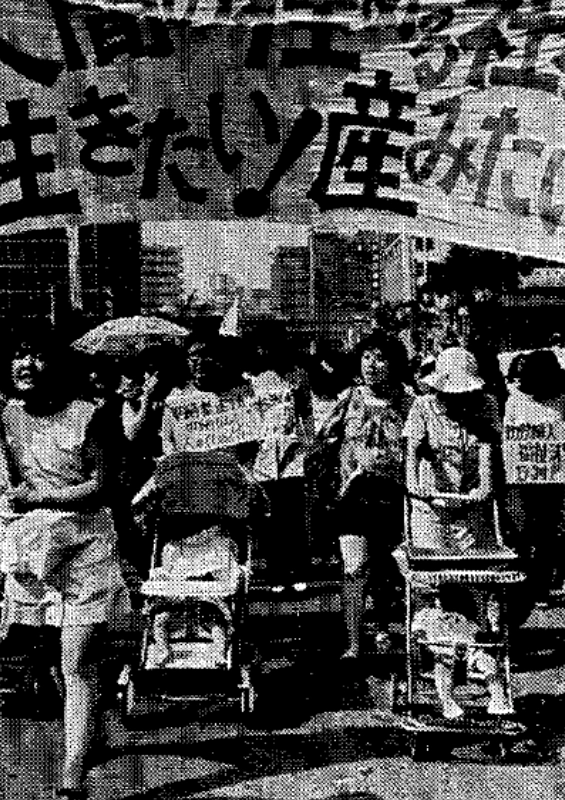
A well-known Ribu commune in Tokyo, called Tokyo Komu-unu, was established in August 1972 and took its name by abbreviating and combining the words for giving birth and commune. Four Ribu women lived together with four children as part of the commune “to search for a new kind of relationality between woman and children.” These Ribu activists sought to redefine and create new conditions for raising children that rejected the “sacrificial mother” paradigm that placed all the responsibility on the birth mother. Ribu women theorized the meaning of their new communal formations in their own alternative zines and journals. While this statement may seem banal in the twenty-first century, the ideological work of delinking motherhood from the family system was itself a radical break.
Given the extent to which bloodlines and family lineage have been constitutive of Japan's social structure and systems of discrimination, the disruption of the ideological and state regulation of motherhood was a stark violation of this patriarchal basis of power. As they lived together from 1972 to 1975, these women organized several “baby-stroller demonstrations” against department stores, Japan Railway, and museums, protesting their policies against the use of strollers—policies that reflected a norm that mothers and infants should remain in the home.
Ribu activists sought to expose how motherhood was only legitimate through its confinement to the hetero-marriage–family system, which they explicitly critiqued as the monogamous “one-husband and one-wife” system. By denaturalizing how motherhood had been normativized as apolitical, they politicized and questioned the freedom of giving birth. Ribu thus decoupled the legitimacy of giving birth from the marriage system and emphasized the need to create the socioeconomic and cultural conditions under which women could freely determine whether to give birth. Ribu's slogan regarding women's procreative capacities called for “the creation of a society where we want to give birth,” a position that emphasizes women's procreative capacities and differs from the “abortion-as-women's-right” approach of many liberal and radical feminists in the United States (Luker, 1984).
Ribu women and their children faced discrimination, ostracism, and economic disadvantage for refusing to legally marry and have their children within the confines of the family structure documented in the family registration system. Despite the movement's fundamental critique of the family system, some Ribu women were already married when the movement began, and others married later. Although not all Ribu-identified women refused to marry or chose to annul their marriages, this critical stance toward the family system remained a core perspective distinguishing ūman Ribu from its predecessors.
Ribu and Abortion
In the postwar period, abortion remained a criminal act, following laws instituted in 1880. However, as a means of population control, the Eugenic Protection Law was revised in 1948 to include a clause that allowed women access to abortion “for economic reasons.” ūman Ribu's sustained protests against later revisions to the Eugenic Protection Law became the most visible campaign of the movement and initiated a feminist legacy of activism that continues today. Ribu activists were fundamentally critical of the government's attempts to control women's bodies as reproductive machinery for nationalist economic growth and clearly saw the proposed revisions in the early 1970s as a recurrence of the government's efforts during wartime to utilize women's bodies for capitalist and imperialist expansion.
Although a woman's right to abortion is often assumed across feminisms, Ribu's politics around abortion emphasized reproductive freedom from state control rather than “women's rights” to abortion granted and protected by the state. Appealing to state proctorship was antithetical to Ribu's stance against state control of women's reproductive freedom.
When the revised law was presented before the Diet in 1972, Ribu groups organized independently, with groups in Sapporo, Kyoto, Osaka, and Fukuoka holding their own anti-revision demonstrations and meetings. When the revision returned to the Diet on 14 March 1973, the Ribu Shinjuku Center appealed to organize together. Ribu women then staged a demonstration and sit-in at the Ministry of Health and Welfare (12–15 May 1973), demanded a meeting with ministry officials, and denounced the failure to consider women's perspectives. Ribu women were eventually carried out by officials and police—images that made national news.
As the movement pushed outward, state power pushed back: arrests, detention, indictments, surveillance, and police raids of organizing centers in Tokyo followed, exacerbated by Ribu's support for women members of the United Red Army. The Shinjuku Center received no state funding or sponsorship, and sustaining the commune financially was a constant pressure.
Many observers have stated that Ribu ended in 1975. Such interpretations miss how Ribu's political ontology extends beyond a narrow rubric of a public-facing movement. Tracing the continued activities of Ribu activists reveals multiple temporalities re-articulated across lesbian activism, feminist music and martial arts, women's communes, and ongoing reproductive freedom movements. Ribu remains a political identity and living philosophy embodied into the present continuous.
Conclusion
Ūman Ribu's legacy remains vital to understanding subsequent trajectories and contentions across feminist formations in Japan—and offers lessons for social movements beyond Japan. Attempts like Ribu, carried out apart from robust social resources, are difficult to pass on to society. A pressing challenge for social work is how it can contribute to movements that exist as extensions of “daily life,” supporting their durability and transmission.
References
- Inoue, Teruko, et al. (2002). Iwanami Encyclopedia of Women's Studies. Tokyo: Iwanami Shoten.
- Luker, Kristin (1984). Abortion and the Politics of Motherhood. Berkeley: University of California Press.
- Nishimura, Mitsuko (2006). The Women's Collective: Rereading 1970s Women's Lib. Tokyo: Shakai Hyoronsha.