
The need for courage and action in an unfair world
Both of us have witnessed active wars after the Second World War — including the wars around the breakdown of the Yugoslav Federation at the end of the 20th century, and the unending wars that Israel has been part of. We have witnessed these as citizens of countries at war, as social work researchers, and (for one of us) as a social worker in a country at war.
We have also had additional experiences of other countries at war through a variety of projects (e.g., in Bosnia and Herzegovina during 1999–2001, visiting Chile in 2006), and editing the first book on social work in political conflicts (Ramon, 2008).
In 2013 a group of social work educators from several countries, supported by the IASSW, approached all members to gauge readiness to include the impact of wars in their curriculum (Duffy et al., 2013). Responses from countries not at war were that curricula were already full; responses from countries at war were clear: this must be included.
In February 2022 we established a Solidarity and Support Group with Ukrainian social work lecturers, students and practitioners, meeting online monthly, building on an EU project introducing social work education to Kyiv and Odesa (1993–2000). Its latest speaker, Dr Marina Rota, presented on the ChildMove project (unaccompanied children from Africa to Belgium, Greece and Italy). Two talks on working with women in Afghanistan and Afghan women abroad will follow, and in May 2025 we will hold our 50th solidarity meeting.
Our edited book, Social Work in War-Torn Contexts: “From that Moment There Was No Peace”, is being published by Springer Nature in June 2025. It contains contributions from ten countries on key issues concerning wars and their impacts on people and their social workers — both in countries at war and in countries receiving refugees, unaccompanied children and asylum seekers.
Chapters include Afghanistan, post-war Bosnia and Herzegovina, Greece, Italy, Northern Ireland, Serbia, South Sudan, Syria, Ukraine and the UK, focusing on disabled people, women, older people, displaced people, unaccompanied children, asylum seekers, and the experiences of social workers and service users.
We have volunteered to teach our social work students during 2024–2025 on what they need to know when working with these groups. Despite a global increase in active wars, this theme does not appear in our countries’ social work curricula.
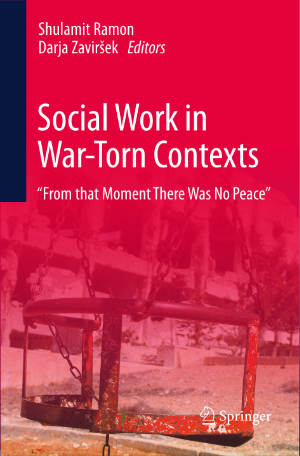 Image: Springer Publishing
For example, the UK currently has a refugee population of around 355,000 (since 2022): approximately 250,000 from Ukraine, 44,000 from Hong Kong, 31,000 from Afghanistan and 30,000 from Syria. This excludes 138,000 asylum seekers awaiting decisions. In August 2024, an attempt to start a fire in a hostel for asylum seekers was thwarted; the ringleader was jailed, though some politicians have called for his release.
A Ukrainian refugee, now in the UK and still teaching social work online in Kyiv, contributes to our sessions. We focus on the needs of people displaced by crisis, lessons from resilience-building projects, and learning from local organisations supporting refugees. Students express concern — and reveal a gap in knowledge beyond what TV news provides.
Duffy and Coulter (2025) write about Northern Ireland’s move from The Troubles (1968–1998) to the 1998 peace agreement — a rare positive outcome of war, leading to non-violence, integrated education and a new government led by a woman who renounced violence. Health and social care recognise the need to transcend religious divisions, though take-up of integrated education remains slow. Notably, Queen’s University brought service users into teaching about The Troubles long before “experts by experience” were common, with high student satisfaction. Discomforting Pedagogies (Zembylas & McGlynn, 2012) are proposed as necessary for the near future.
Social workers’ professional contribution is vital during war and in supporting victims of war who move to safer countries. Social workers in countries at war are themselves affected — hence the concept of Shared Traumatic Reality (Nuttman-Shwartz, 2025) and its practice implications. Balancing professional and personal obligations is demanding, especially when social workers disagree with their government’s position on a conflict.
One conclusion of the 2025 book is the need for more education focused on war, peace and post-war periods; on the role of social work; and on current ethical questions — e.g., the criminalisation of men refusing military service, denial of genocide, sexual violence during conflict, and the treatment of children emerging from military formations.
One of us has created a new Masters module, Social Work in War and Post-War Period: Working for Peace, at the University of Ljubljana. It examines armed conflict historically and comparatively, emphasising social work’s role in helping people in need, and engages with key international documents to stimulate peacekeeping, peacebuilding, war prevention and post-war reconciliation from a social work perspective.
The second initiative, for final-year BSc and MSc students at the University of Hertfordshire (UK), focuses on resilience during and after wars: fostering resilience; case studies across age and gender; and learning from local social workers, UK-based war refugees, and NGOs working with this group.
References
- Duffy, J., Ramon, S., Guru, S., Cemlyn, S., Lindsay, J., & Nuttman-Shwartz, O. (2013). Opportunities and challenges in developing a social work curriculum on political conflict. European Journal of Social Work, 16(5), 689–707.
- Duffy, J., & Coulter, J. (2025). Northern Ireland: Educating for peace in post-conflict society. In S. Ramon & D. Zaviršek (Eds.), Social Work in War-Torn Contexts: “From that Moment, There Was No Peace”. Springer (forthcoming).
- Ramon, S. (Ed.). (2008). Social Work in the Context of Political Conflict. Birmingham: Venture Press.
- Nuttman-Shwartz, O. (2025). The shared traumatic reality of social workers and the people they support in war-torn contexts. In S. Ramon & D. Zaviršek (Eds.), Social Work in War-Torn Contexts: “From that Moment There Was No Peace”. Springer (forthcoming).
- Zembylas, M., & McGlynn, C. (2012). Discomforting pedagogies: Emotional tensions, ethical dilemmas and transformative possibilities. British Educational Research Journal, 38(1), 41–59.