



Social Innovation Laboratory for Rural and Peri-urban Areas (ODS Rural Labs its original acronym) is a participatory research-action project designed ad-hoc by a research team from the Degree of Social Work at the Universidad de Zaragoza, Spain , with an interdisciplinary advocacy . Our main proposal is to carry out community diagnoses "in SDG perspective" in order to connect the logic of the SDG with specific needs identified by local actors, but not only stays at a diagnosis level, it engages co-creation practices to move forward social action with local citizens of the rural territories. Starting from 2018, the project has reach five years of experience in seven different territories and recognition from different institutions as a good practice example of Community Social Work intervention. In 2023, was selected by the Spanish Agency for International Development Cooperation (AECID) and the Spanish Federation of Municipalities and Provinces (FEMAP) as a good practice of Global Education and SDG promotion.
The participation of local actors is fundamental as they contribute with their popular and political knowledge required to perform a local community diagnosis (Marchioni 1999, Lillo and Roselló 2004). However, the laboratory is also an interdisciplinary space in which professors, university students and local communities come together in order to contribute in the implementation of the project (Almaguer-Kalixto and Escriche, 2020). For this reason, the laboratories are a favourable space for community social work insofar they enable the interaction of local actors, administration representatives and social science experts in citizen science framework (Serrano et al 2014).
Echoing global views of Social Work
The Global Agenda of Social Work and Social Development, has already pointed out the potential of social work to influence and contribute to sustainable development and in particular to the current 2030 Agenda is promoted. As mentioned by Truell, Jones and Lima et al (2017), the contribution from this discipline is not only about monitoring that governments and institutions are committed, community projects for citizen training should also be promoted.
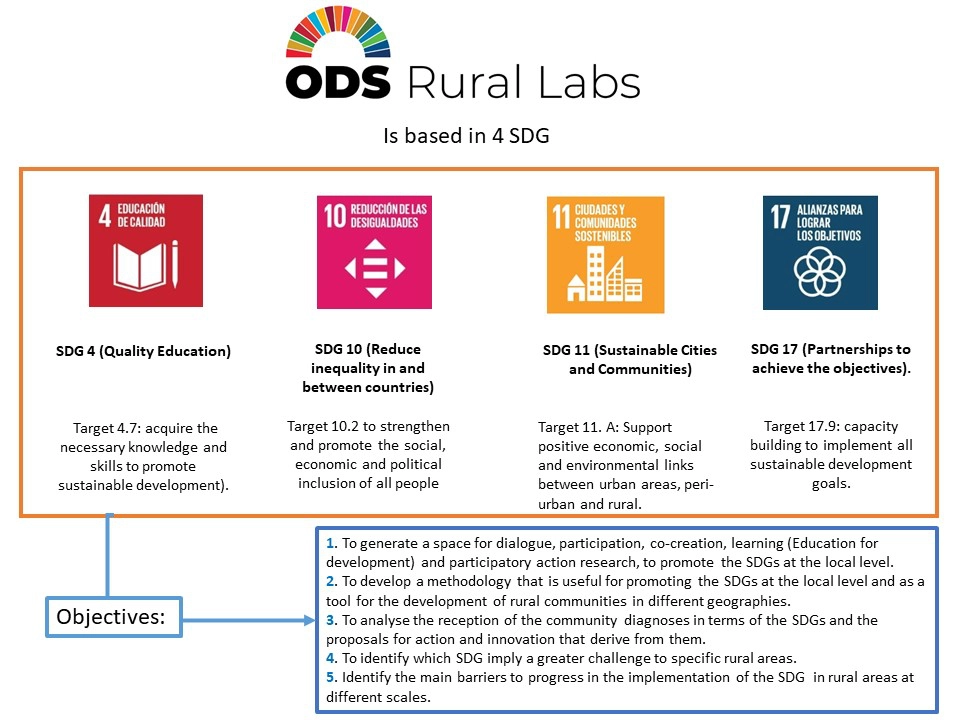
ODS Rural Labs project proposes an opportunity to work with active methodologies that involve the population in the analysis and design of proposals related to the community and the 2030 Agenda; from their perspective, enabling to target real challenges that relate each SDG to their context. Many cases of social innovation labs have been running in the urban sphere, however less attention has been given to rural areas, were SDG are perhaps, more urgent. In addition, it is important to reinforce the complexity of rural areas and its contribution for global sustainable development. For instance, although SDG 11 refers to cities and sustainable communities in its title, in general Agenda 2030 makes short reference to rural contexts. Therefore, among our objectives is to enhance the concept of Sustainable Rural Communities. The project is thus, in 4 SDG as presented in the next illustration
Methodology, execution strategies and implications as a model
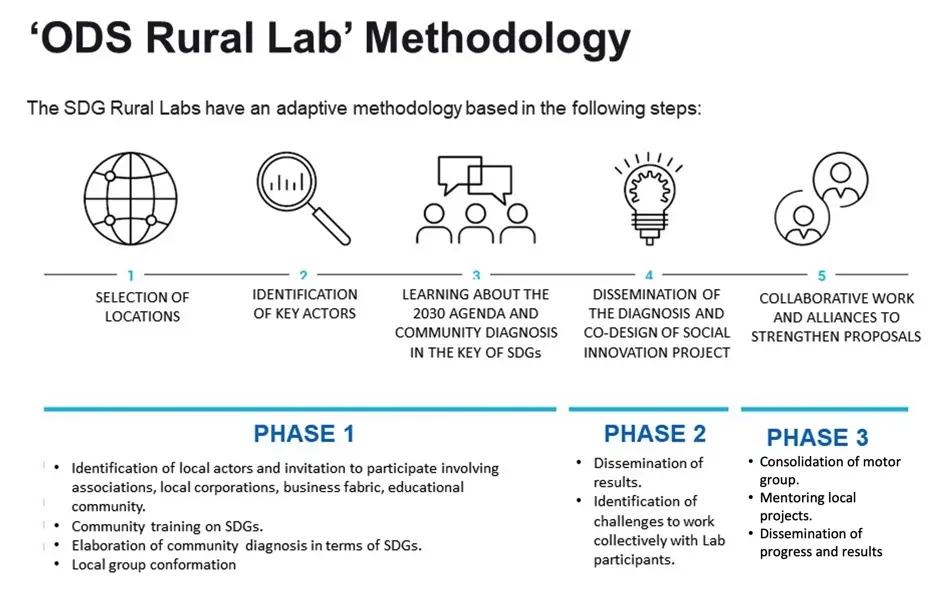
We apply a systemic approach of social innovation processes, based on social innovation laboratories (Westley and Laban 2011) and sociocybernetics (Geyer, 1995; Scott, 2021). The goal of each laboratory is to develop an adaptive change strategy engaging heterogeneous actors from different social groups. By introducing new information about SDG and particularly, promoting reflexivity through the sessions. All those who participate investigate and seek to generate new knowledge about how their immediate environment works and, above all, how it can be transformed.
ODS Rural Labs project has roots in participatory action research allowing citizens to define the guidelines and objectives of the research process and its results (Balcázar 2003, Barton, Stephens and Haslett, 2009). The use of Information and Communication Technologies (ICT) is complementary, however the context of the COVID19 pandemic in 2020 showed that new technologies where key to adapt projects to others forms of participation through online community work strategies (López and Marcuello 2021, Almaguer, Borobio and Eito 2021) that enable to follow up the processes in a virtual manner.
What has been achieved so far
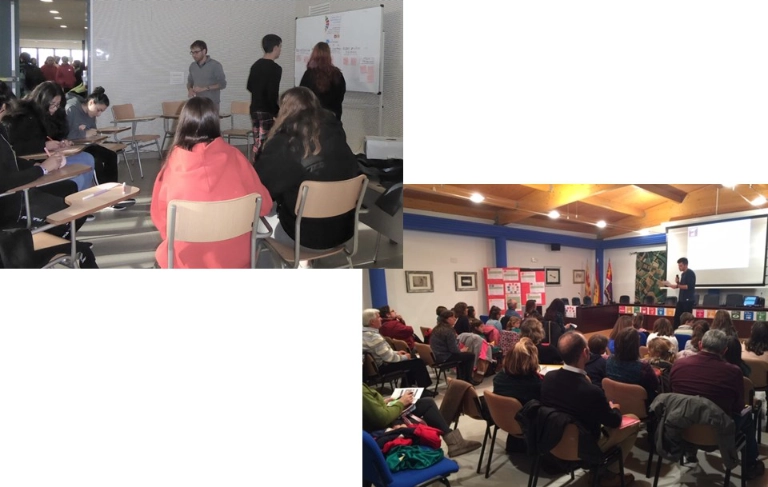
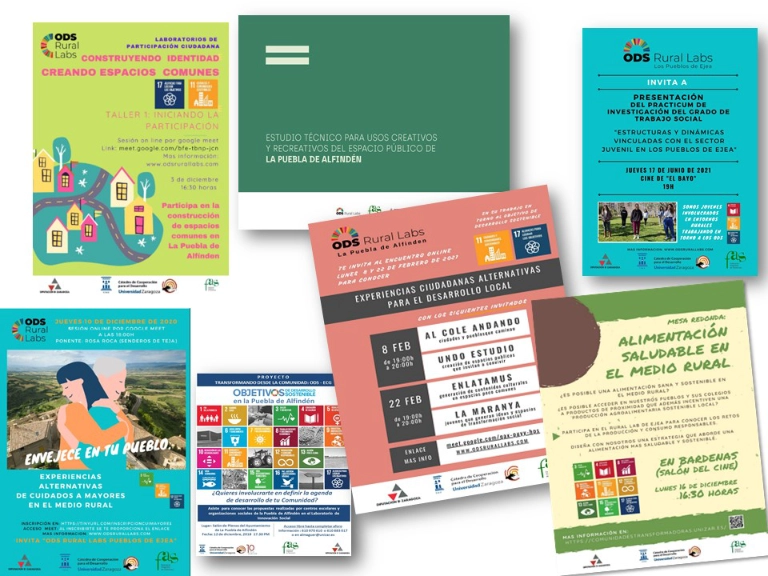
In 2018, we started two pilot experiences in different territories of Zaragoza Provence. On the one hand, 5 small villages belonging to the municipality of Ejea de los Caballeros, with population ranging from 100 to 300 inhabitants each of them and with a strong agricultural background. In this case, sinergies were made with the local rural school Colegio Rural Agrupado Luis Buñuel, wich was key in the engagement of neoghbours and local associations. The second territory was a radically different, La Puebla de Alfindén, a municipality near Zaragoza, the capital of Aragon, that remained rural until the 1960s but had had a rapid industrial growth from 1000 to 5000 inhabitants. Tis rapid growth and migration has been difficult to fit in their identity and social cohesion. In this case, a local action group was created with a heterogeneous profile from commerce, education, cultural and political spheres and the emphasis was given to promote the youth participation in the activities of the Rural Lab.
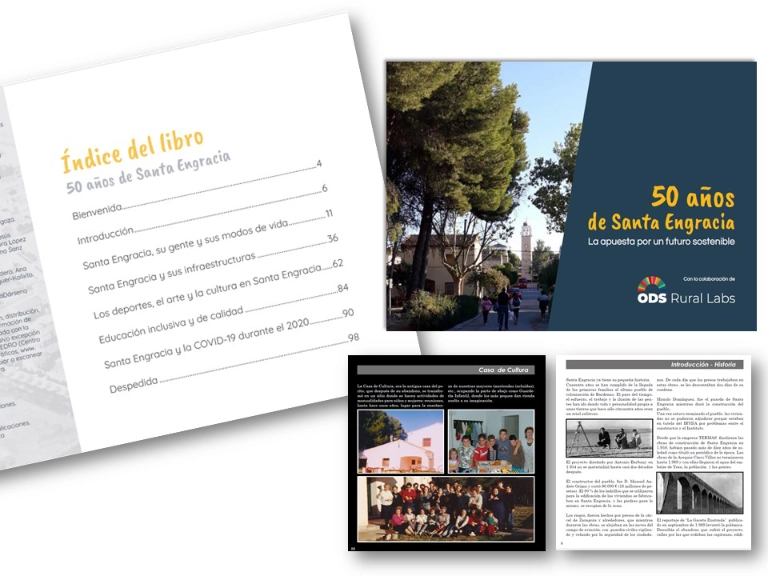
The third laboratory was developed from 2019-2021 in Santa Engracia, Tauste. In this village with 274 inhabitants, the school also played an important role as a local facilitator. Although the process was interrupted due the pandemic and mobility restrictions, we developed virtual strategies to keep in contact. Thanks to that we could complete the edition of a local book elaborated by the local participants which included the history, but also the social diagnosis elaborated in the Lab. The book was presented until 2021 and was proudly celebrated and presented by the local actors.
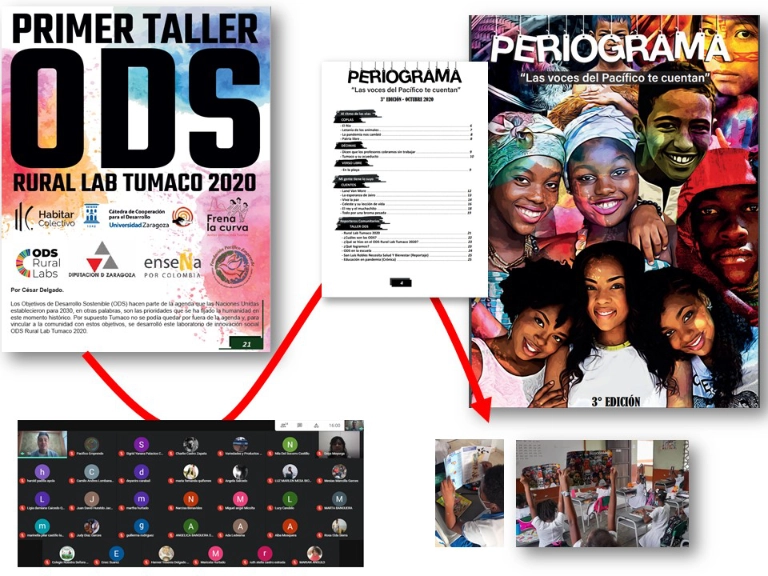
Despite the COVID19 pandemic, we came into contact with other initiatives, such as Frena la Curva , which called for projects to strengthen the social fabric during the pandemic. Thanks to this participation, we establish contact with international organisations interested in the methodology. As a result, in partnership with Fundación Pacífico Emprende, a Colombian NGO we developed a virtual laboratory from September to November 2020 in Tumaco, Colombia. In 2023, a second laboratory has been held in the same territory, this time in presence to reinforce the engagement with local actors. Participants of the first lab, which was a success despite the online format and the structural difficulties for participants to connect (poor internet connection, difficulties due the pandemic restrictions), elaborated a magazine as a titled PERIOGRAMA coordinated by local teacher César Delgado. It included local narratives, poetry, and the results of the social diagnosis. The material is used as a reading material in schools, with few reading resources in Tumaco.
New territories have subsequently joined the Laboratory, we currently have 10 municipalities engaged and two territories abroad, in Tumaco, Colombia and Hassilabied, Morocco. All these practices and local interventions, in terms of community social work, are also a teaching innovation field that is linked to specific courses where teachers design practices to bring a "real" project that is being implemented to specific contents of their subjects.
Looking forward: beyond 2030
ODS Rural Labs intervention allows local actors to actively participate in their agenda of development priorities and this is directly related to having a more just and equitable society. The SDGs can be a connector between local needs and the global agenda. t is there where the ODS Rural Labs play a fundamental role. If this diagnosis is collective, it is easier to encourage local actors to propose innovative ideas to improve and advance, analysing what already exists, making alliances and following up on the administration.
From our perspective, the best way to promote SDG for social work students is through action-research projects where they not only analyse, but seek to contribute to specific social transformation through knowledge, research and intervention. SDG is a grid of objectives based in human rights with no temporary deadline. The ODS Rural Labs allows us to transmit the idea of the importance of generating scientific and verified knowledge to be able to transfer solid methodologies to the communities, which can sustain their results.
References
Almaguer Kalixto, P.E., Escriche Bueno, P.J. y Eito Mateo, A. (2023) ODS Rural Lab Guía práctica y caja de herramientas. Diputación Provincial de Zaragoza. Zaragoza, Prensas Universitarias.
Almaguer-Kalixto, P.E. & Escriche, P. (2020). Laboratorios de innovación social: contribuciones al aterrizaje de los ODS en el contexto rural. En P.E. Almaguer-Kalixto, M. J. González Ordovás, Ch. Marcuello-Servós (Eds.) Políticas Públicas y Sociales: ¿Ideología, Idolatría o Propaganda?: La Globalización Social, Económica y Jurídica (pp. 47-62). Zaragoza, Prensas Universitarias.
Balcázar, F. (2003). Investigación Acción Participativa (IAP): Aspectos Conceptuales y Dificultades de Implementación. Fundamentos en Humanidades, Revista de la Universidad Nacional de San Luis, 4(007-008), 59-77.
Barton J., Stephens J. & Haslett, T. (2009). Action research: Its history and relationship to scientific methodology. Systemic Practice and Action Research 22(6), pp. 475-488.
Fermín Serrano Sanz, Teresa Holocher-Ertl, Barbara Kieslinger, Francisco Sanz García and Cândida G. Silva (2014) White Paper on Citizen Science for Europe. European Commission.
Cañas, A. & Almaguer-Kalixto, P.E. (2019) Diagnostic participatif et plans de développment rural durable dans les comunes de Taous et de Mcissi, dans la región de Draa-Tafilalet, Maroc. CERAI.
Geyer, F. (1995) The Challenge of Sociocybernetics. In: Kybernetes 24: 4 pg 6-32
Lillo, N. Roselló, E. (2004) Manual para el trabajo social comunitario. Narcea Ediciones: Madrid
López-Peláez, A., & C. Marcuello-Servós. (2021). “Digital intervention, COVID-19, and critical realism: Toward a science of digital social work.” Journal of Sociology&Social Welfare 48(3). scholarworks.wmich.edu.
Marchioni, M. (1999). Comunidad, participación y desarrollo: Teoría y metodología de la intervención comunitaria. Popular.
Truell, R. Jones, D, Lima, A. (2017) Servicios Sociales y Política Social (Abril-2017). 24 (113), 137-153.
Scott B (2021) Cybernetics for the social sciences. Brill Research Perspectives in Sociocybernetics and Complexity 2(1).
Westley, F. & Laban, S. (eds.) (2011). Social Innovation Lab guide. Waterloo Institute for Social Innovation and resilience: Waterloo.
You may find more information of the project in www.odsrurallabs.com