 Social Dialogue Magazine
Pedagogical project of the social service graduation course of the Pernambuco Federal University, UFPE, Brazil
Presentation: After the approval of the Code of Ethic of 1993, the Brazilian Association of Teaching and Research in Social Work - ABEPSS began a process of evaluation and curricular review of graduate Social Work Courses in Brazil, from intense mobilization work in the various Units Teachings.
Within this process, the theoretical-methodological principles of the new curriculum and the social direction of professional education were defined, considering the demands of the labor market, the hegemonic ethical-political project of the profession and the profile of the graduate.
The elaboration of the new curriculum has become imperative due to:
- The changes that occurred in the national conjuncture that placed new demands on the Social Work professional and caused changes in the traditional demands on the profession; requiring different answers from those presented by the category so far.
- The theoretical and methodological maturation of the profession, which allowed a more qualified reading of the reality and the demands posed by the various social factors present in the Brazilian conjuncture and the professional formation itself.
- The capacity developed by the professional category to create the necessary answers to confront the social issue in the country.
The final version of the minimum curriculum proposal was built at the II National Workshop on Professional Education and approved at the General Assembly of the Brazilian Association of Social Work Education - ABESS - held on November 7 and 8, 1996 in Rio de Janeiro.
The curriculum was then called the General Guidelines for the Social Work Course and presented to MEC / SESU for consideration.
While the proposed Curriculum Guidelines proceeding through the competent bodies, the ABEPSS and Social Work Education Units, and monitor the process and position itself as the demands and proposals of the MEC / SESU, started the Pedagogical Projects preparation process for Graduate Courses, with local and regional workshops.
Therefore, the Pedagogical Project of the graduate Course in Social Work at the Federal University of Pernambuco is the result of a collective discussion process, coordinated and systematized by the Graduate Collegiate, appreciated and approved by the Departmental Plenary.
Core Nodes
According to the Curriculum Guidelines for the Graduate Course in Social Work, the Education Professional Projects to be built and implemented in the Teaching Units must promote the articulation of a set of inseparable knowledge that translates into Core Nodes which are:
- Core of theoretical and methodological foundations of social life that comprises a set of knowledge that allows the treatment of social being as a historical totality.
- Core of the foundations of the socio - historical formation of the Brazilian society that provides the theoretical contributions to the knowledge of the economic, social, political and cultural constitution of the Brazilian society.
- Core of professional work that focuses on the understanding of Social Work as a profession registered in the socio-technical division of work, the discussion of the theoretical and methodological production of Social Work, as well as providing the conditions for the technical-cooperative training necessary for professional performance.
Principles
Such contents should be treated according to the principles of:
- Flexibility and dynamics of full curricula;
- Strict theoretical, historical and methodological treatment of social reality and Social Work;
- Adoption of a critical social theory that allows the apprehension of the social totality in its dimensions of universality, particularity and uniqueness;
- Establishment of the investigative and interpretative dimensions as formative principles and central condition of education training;
- Presence of interdisciplinarity;
- Inseparable dimensions of teaching, research and extension;
- Exercise of pluralism as a proper element of academic and professional life.
Objectives
General:
Promote the theoretical-methodological, technical and ethical-political qualification for the exercise of Social Work as a specialization of collective work.
Specific:
- Understand bourgeois society in its contradictory movement.
- Critically analyze Brazilian society in its regional and local diversity, understanding the particularities of the development of capitalism in the country.
- Understand the dimensions that permeate the social meaning of the profession and the constituent elements of Social Work as a specialization of work
- Understand the ethical, historical, theoretical and methodological foundations of Social Work and the work processes in which it operates.
- Identify and analyze the demands to the Social Work, building answers that potentiate the tendencies of confrontation of the social question in the Brazilian reality.
- Develop competences and technical-operative skills according to the law of regulation of the profession of Social Work - Law No. 8.662 of 06/07/1993
Bachelor Profile in Social Work
The course is expected to generate a professional with:
- Theoretical-methodological capacity for a critical apprehension of the historical process as a totality, which implies understanding it mainly in its dynamic and contradictory movement, in its universal, particular and singular constitution, in the mediations and spheres of social life.
- Investigative training in the search for an explanation of the historical formation of Brazilian society, in order to grasp the particularities of the constitution and development of capitalism in the country and also as a basis for explanation of Social Work in social relations.
- Ethical-political capacity that consolidates the values and principles legitimized in the Code of Professional Ethics and makes it possible to apprehend professional practice in its teleological dimension.
- Training to grasp the demands - traditional and emerging - placed in the labor market and to formulate responses, strategies, tactics and instruments that enhance the coping trends of the social issue.
- Technical and political training for the management of social services at the state and private levels.
Curriculum
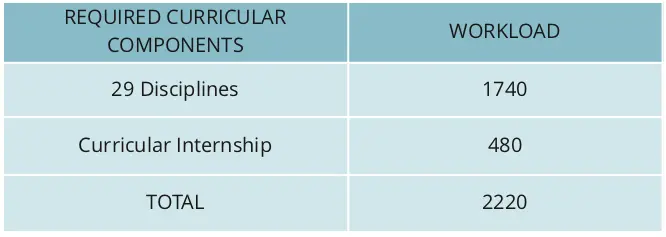
The Education Program that we formulated for Social Work Graduate Course of UFPE has a curriculum consists of compulsory and elective courses, workshops, seminars, compulsory traineeship and Work Course Conclusion (TCC) over 8 semesters, totaling 3100 (three thousand one hundred) hours the payment of the workload.The required curricular components are composed of 29 Disciplines (1740 hours), Curricular Internship (480 hours) and Course Completion Work (TCC), totaling 2220 hours.subjects.
The workload of complementary activities refers to monitoring, research and extension activities.
The placement of internships in the various occupational spaces of intervention of the Social Service aims to enable the student to practice, enabling him / her to identify and analyze the demands of the profession and, under the technical and pedagogical supervision, generate answers that meet them.
It is also a curricular requirement to obtain a Bachelor of Social Work diploma, the elaboration of the Course Conclusion Paper, which will deal with a significant topic for the professional debate and will constitute a moment of synthesis and expression of the entire professional formation. This work will be evaluated by an examining board composed of two teachers who will give grade upon written opinion.
.webp)
.webp)
.webp)