 Social Dialogue Magazine


Children Of Commercial Sex Workers (CSWs): Understanding Vulnerabilities To Undermine Them
Trafficking, prostitution and interwoven issues of human rights have evoked significant responses from contemporary social work and feminist research trends. However, it is often ignored that when human trafficking takes place, victimization occurs at multiple familial, social, and inter-generational levels. Limited attention is paid to children of trafficked women who are equally open to facing unique stigma and discrimination as a result of their mother's profession. These children become victims of their circumstances from birth and are often absorbed into the family trade of commercial sex-work. This research article looks into macro and micro level vulnerabilities faced by children of sex-workers; alienating them from mainstream education, health and protection services. On one hand, prenatal and postnatal exposure to unfavorable environment is researched to result in a range of adverse outcomes for these children, including physical, psychological, social and emotional development delays to trauma, neglect, abuse, and displacement. On the other hand, these undesirable conditions also reveal space systematic social work interventions in home, community, civil society and policy spheres.
Contextualizing Vulnerabilities
Prostitution, varying from its ancient cultural and religious beginnings, is researched to be one of the oldest professions in the world (Garg, 2017). In contemporary times, prostitution and trafficking have emerged as organized forms of businesses across the globe. They thrive as structured systems of exploitation of young girls, women and children and result in methodical commercialization of flesh trade.
Over the years, prostitution as a profession has taken up several forms and manifestations including street prostitution, individual escort services and community based prostitution, which is executed in brothels and red light areas. Catalytic facilitation of prostitution is associated with various dehumanizing activities like soliciting, pimping, trafficking, procuring, and brothel keeping. There are multiple stakeholders involved in commercial sex trade; ranging from pimps, landlords/landladies, touts, customers, money-lenders and CSWs themselves (Bullough & Bullough,1987). In this feudal categorization, it is the sex worker who falls lowest in hierarchy and is subjected to multi-faceted exploitation.
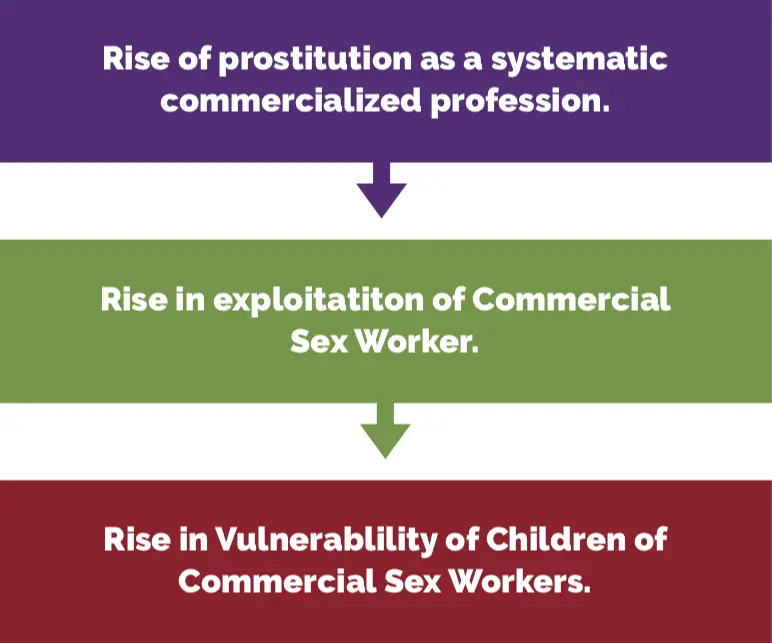
Prostitution and interwoven issues of human rights has evoked significant responses from contemporary social work and feminist research trends (Patkar, 2013). However, it is often ignored that when human trafficking takes place, victimization occurs at multiple familial, social, and inter- generational levels. A majority of anti-trafficking interventions fail to address human rights issues pertaining to ‘children of CSWs.’ As illustrated in Figure 1, children of women in prostitution emerge as an indispensable part of this exploitative contextual framework. They reside in areas of sex industry like brothels with their mothers, grow up in an unhealthy and unsafe environment and remain at high risk of discrimination, abuse, violence and neglect.
Children of Commercial Sex Workers: Identifying Vulnerabilities A large number of CSWs have children of their own or even seek to adopt other children (Ling, 2001). It needs to be understood here that despite her profession, the sex worker is a woman and has a natural desire and natural and positive right to bear a child. In her position of extreme social condemnation and rejection, her child alone is her hope for an alternative future, source of human relationship and sane survival (Patkar, 2013).
However, these children of CSWs are open to facing unique stigma and discrimination as a result of their mother's profession. As depicted in Figure 2, they face layers of macro and micro level vulnerabilities, which alienates them from mainstream education, health and protection services (Sircar & Dutta, 2011).
1. Inadequate living conditions and patterns
Besides being born with the stigma of illegitimacy, children of CSWs grow up in areas of commercial sex work, where pimps, brothel keepers, clients and other anti-social elements have a direct impact on the children’s upbringing.
These children live in small dingy, ill- ventilated rooms, lacking proper toilet facilities and water supply (Karandikar, Gezinski, & Meshelemiah, 2013). They often move around in unsanitary, congested and crowded bye lanes of the area and do not have an quiet and clean space to sleep, rest, study, or to cook and eat healthy food. Since these areas come alive primarily during night time and their mothers work until the wee hours of night, the children do not often have the comfort of following a stable daily routine of sleeping and studying at healthy timings.
2. Limited access to education
A majority of the mothers who are CSWs are themselves victims of illiteracy and dropping out of school. They, hence, have their own limitations in supporting and understanding the demands of their children’s schooling and education. A study conducted with a sample of 600 children of CSWs, it was found out than more than 25% ‘opted’ to not attend school (Pandey, 2010).
There are various reasons why these children to do have access to adequate educational opportunities. These may include not having a good school in their neighborhood, not having needed resources, time and space to study, lack of parental support to foster educational habits, facing stigma and bullying at school due to their mother’s profession.
.webp)
3. No legitimate opportunities to ‘play’
While the mothers are busy with their clients, children of CSWs have few opportunities for legitimate play. They are often busy in helping with household chores, taking care of siblings, and even entertaining and serving refreshments for clients. Consequently they become onlookers and participants in unsavory adult activities, including dancing in shops for customers, consensual sexual acts, gambling, drinking and taking drugs. They often start becoming targets of commercial sex work themselves.
4. High health risks
Children living in brothels, in unhygienic and contaminated households, are often at high risk of catching diseases. Sexually transmitted infections (including HIV/AIDS) are a major health risk for children with parents who have multiple partners. Awareness of the health hazards might be present among CSWs, but many clients are unwilling to use condoms. These children are also often vulnerable to addiction and widespread use of tobacco, alcohol, opium and other addictive substances (Ling, 2001).
5. High instances of child sexual abuse
Being born and brought up in brothels, children of CSWs, especially young girls often learn to relate to others, gain approval and attention by using their sexuality, which can increase their vulnerability to sexual exploitation (Ling, 2001). They see their mothers, aunts and sisters as role-models and seek to themselves follow them into sex work. Most have their first sexual experience by the age of eight or nine, even before gaining puberty.
6. Skewed understanding of family roles and moral values
Children of CSWs are at a higher risk of developing skewed and ambiguous perception of family roles and responsibilities. A stable and nurturing father figure is mostly missing in the lives of these children. Within a patriarchal set-up, their mothers often are seen as subjects of societal condemnation and disapproval. They also witness their mothers being beaten, and humiliated by clients, pimps, brothel owners, and the police. Exposure to such distorted value systems from birth leads to psychological conception of unorthodox morality, in which commercial sex work, violence and victimization of women is normalized in day-to-day life.
7. Lack of future opportunities
Children of CSWs know they are not accepted by society and are subjected to a sense of insecurity and shame about their birth and family. Stigma and societal marginalization results in lack of future job prospects. Young girl children become prone to becoming CSWs themselves. Young boys, on the other hand, become involved in the sex trade, either directly as pimps and trafficking agents, or indirectly by working in local clubs, selling drugs or alcohol. Even if these children do not get involved in commercial sex work, they lack skills, qualifications and social and economic capital to secure formal sector jobs.
.webp)
Children of Commercial Sex Workers: Responding to Vulnerabilities
Social work response to these multiple vulnerabilities faced by children of CSWs also needs to holistic in nature. Instead of just working with the children in isolation, vulnerabilities should be addressed by intervening differently with different inter- related stakeholders and social structures, as represented in Figure 3.
1. Parents/Mothers
- Rescue, Rehabilitation and Reintegration – A comprehensive process of well-planned rescue/raid, integrated rehabilitation on all fronts and then a systematic procedure of social reintegration can be carried out with the commercial sex worker. This can have a direct positive impact in the living conditions, household and quality of life of their children.
- Awareness and Consciousness Development – The CSWs need to be seen as conscious decision makers of their own lives and body. They should be well- informed about the consequences and responsibilities of having a child.
- As preventive mode of intervention, they can be made aware of safe contraceptives and birth control options to avoid birth of unwanted children or of children who might be prone to being born as HIV Positive, or who might not get the required care and nurturing.
- As protective mode of intervention, once children are born, awareness and consciousness raising among parents need to take place about significance of child-education, proper health care, mandatory protection from abuse and neglect, and opportunity to grow into socially responsible adults.
- Education and Skill Development – Adult literacy and vocational training opportunities need to be made available for CSWs. This can open doors for alternate employment and livelihood options for them and their children.
2. Community
Residing in an area of sex-industry and being an on-looker to illicit activities, which occur in this ‘community’, can be detrimental for the children and can lead to child labor and child prostitution.
- Relocation to an alternate community- The first option should be to relocate the child from an unsafe and unhealthy surrounding and find alternate, more conducive living arrangements, foster care, institutionalization, or alternate housing for mother and child.
- Creating alternates within the community - If alternates available outside the community cannot be accessed, separate ‘safe spaces’ for children can be created within the community itself. These spaces should be easily accessible, free of cost and constructive for the child’s development. These can include night care centers, day care/drop in centers, play areas, youth vocational training centers etc.
- Community sensitization workshops – and programs about issues of child rights, well- being and protection need to be regularly raised at a larger spectrum. There can be a ‘Community Watchdog Committee’ consisting of responsible members of the area to ensure that no child is involved in unfavorable activities on the street or elsewhere.
3. Government/Civil Society Organizations
Long term changes in the in the lives of this section of children can be initiated through a combination of governmental and civil society intervention.
- Recognition of vulnerabilities – The rights of children of CSWs and their vulnerabilities are often ignored in overall government schemes and policies for children. Hence it is important to decrease invisibilities of this section of child population and bring their needs to the forefront.
- Minimization of vulnerabilities – Additional rights-based services can be implemented through civil society initiatives in terms of health, education, protection, development and participation of these children.
CSWs are often not seen as ‘mothers/parents’, exposing their children to multi-layered vulnerabilities. This article puts forward how prenatal and postnatal exposure to unfavorable environment can result in a range of adverse outcomes for these children, including physical, psychological, social and emotional development delays to trauma, neglect, abuse, and displacement. On the other hand, these undesirable conditions also reveal space for systematic social work interventions in home, community, civil society and policy spheres.
References:
Bullough, V. L., & Bullough, B. (1987). Women and prostitution: A social history (p. 62). Nueva York: Prometheus Books.
Garg, M. K. (2017). Society and Sex Work in The Autobiography of a Sex Worker by Nalini Jameela. Language in India, 17(7).
Karandikar, S., Gezinski, L. B., & Meshelemiah, J. C. (2013). A qualitative examination of women involved in prostitution in Mumbai, India: The role of family and acquaintances. International Social Work, 56(4), 496- 515.
Ling, B. (2001). Growing up in the Brothel. Stockholm: Save the Children Sweden.
Pandey, S. P. (2010). A study of children dependent on prostitutes in selected areas of Uttar Pradesh.
Patkar, P. (2013). Civil society initiative of a decade against human trafficking: An insider’s attempt at looking back. Human Trafficking: The Stakeholders' Perspective, 25.
Sircar, O., & Dutta, D. (2011). Beyond compassion: Children of sex workers in Kolkata’s Sonagachi. Childhood, 18(3), 333-349.