
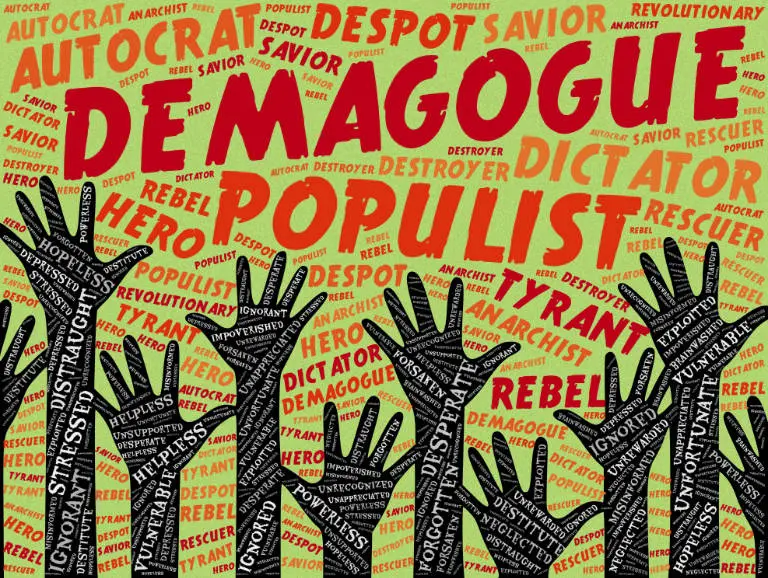

What is this new thing called 'populism'?
Introduction
In this short article, I attempt to gather some ideas that might help address the question: what is this new thing called populism? and give some suggestions as to how social work might respond to the challenge it poses. Mudde (2007) suggests that populism is loosely grouped ideas that have at least three features: anti-establishment, authoritarianism and nativism, and is once again on the rise across the globe. Populists parties, leaders and politics are accused of disrupting and unsettling previous compromises of the past left and right politics that ran amok during the last century. So, what explains this phenomenon?
Definitions While there are many definitions of populism and populist leaders moving from the left to the right spectrum of politics there are some common factors in the search for a definition that many scholars agree.
- Populism arises in the context of a political crisis, when legitimacy of institutions is questioned, and when the political status quo seems incapable of responding to populist demands.
- Populist movements are headed by strong charismatic or messianic leaders who have the fate of the nation in (mostly) his hands.
- Populist leaders more often come from outside the political class, that is they are outsiders to the ruling elites. Their appeal is that they are from the ordinary population and uncontaminated by the political class and their long term enshrined interests.
- Populist leaders appeal to the need to restore what appears to be missing, eg national pride, strong hand against violence and /or political disarray, or a return to honesty, strong leadership, push for more effective social change/ social justice etc.
- Populist leaders make a strong appeal towards nationalism both domestically and as a stance on the international stage.
- Populist leaders expose the traditional elites as the enemy of the ordinary people.
- Populist leaders attach and discredit traditional civil society organisations and political parties who are seen as unnecessary, and useless to the restoration proper power back 'to the people.'
- Populist leaders seem to create followers rather than informed citizens.
- Populism remains a politics of hope - a type of redemptive politics where the messianic leader promises a better world for those left behind or locked out of economic, social and cultural rewards and privileges resulting from the move to neo-liberalism and globalisation. Many articulate a strong argument against the perils of capitalism and the inequality it spawns, even in cases where their power is based.
- The populist cause can, in many instances unite very different grievances
- The populist desire for a (de facto unachievable) unity shows a surprisingly affinity between populist political imagination and totalitarianism and Populist leaders seem to thrive on confrontation, often creating divisions to garnish support (Griffith Review 57, 2017; Muller, 2014; Mudde, 2007; Vieten & Pointing, 2016; de la Torre, 2014).
The reasons (most often cited)
- Economic inequality.
- Anti-immigrant attitudes (fear new migrants/the Other).
- Mistrust of global and national governance.
- Support for authoritarian values.
- Growing anger from the people left behind by progressive tides of cultural change which they do not share (eg older generation, men, The religious, ethnic majorities, less educated).
- Generational conflict,
- and Left-right ideological placement (Inglehart & Norris, 2016; Moghadam, 2013; Torres, 2006).
Paul Ham (2017) in his article "So you want to rule like an autocrat; six-step guide to putting your country first" gives a good overview of strategies to expose the how you too can be a populist leader in the current political flux. Here is a summary of his excellent article.
Tools (ready-made accessories)
- "A handy scape goat" (Muslims, refugees, asylum seekers, the alt-left, Mexicans, women).
- An angry, elderly while majority with a distrust of foreigners.
- An easily mocked 'elite' of harmless academics, writers and liberals (and progressive media and whistle-blowers).
- A list of lies posing as politics.
- A billionaire hedge-fund manager or person with access to unlimited cash.
- A thuggish foreign regime keen to sabotage your democracy (if one isn't available make it up!).
- A complicit press or complaisant press,
- and An ideological poohbah with an apocalyptic message" (Ham, 2017, p.28).
Method (for implementation)
- "Choose your scapegoat and vilify them (can make it up as well).
- Tap your rich donors and crony regime (eg right -wing leaders from any country or puppet leader your government supports).
- Appeal to your press pals (nudge right-wing bloggers with track record in scorn and ridicule and who are known and accepted as serial fabricators eg Shock-jocks.
- Weaponise the internet and subvert your democracy (anti-terrorist laws, increasing police powers, restriction on who and how to protest, increase in surveillance laws).
- Lie and pollute media with these bald-faced lies and fake news (and repeat them until they become 'facts').
- Stoke fears of war and issue apocalyptic threats" (Ham, 2017, pp.28-35).
Social work challenges and response
According to Fazzi (2015) the rise of populism and its more right-wing aspect has yet to be tackled and investigated by the social work profession. Concern focussing on the impact of globalisation and the reorganisation of social services in a depleted and underfunded welfare state because of the unchecked rise of neo-liberal economic, social and cultural policies has resulted in the rise of populist politics and leaders going under the radar of critical analysis and public commentary (Fazzi, 2015). As well as the demise of the welfare state Fazzi (2015) notes that the progressive growth of populist's political ideologies poses further attacks on social works role as protector of human rights and as proponents of social tolerance and a just society. Paralleling further attacks on the welfare state and its universal service provision is the connection between the rise in populism and the demonstrable increase in prejudices against immigrants and members of minority/marginal ethnic groups. Briskman (2016) warns social workers about the challenge the rise in demonising migrants, asylum seekers and refugees are having on the profession and Latham (2016) asks the question about the rise in Islamophobia, e.g. whose side is the profession on?, noting its silence in the public arena. Both these activists challenge practitioners to call attention to the drift towards xenophobia and the victimisation and violence these minority groups face daily.
Another challenge worthy of attention is the temptation of overworked and under resourced practitioners to use populist discourse as an easy 'escape route' to find answers to the almost unsolvable social issues stemming from rising wealth inequality and the profound changes transforming the workforce and society in post-industrial countries. Blame a ready-made victim (eg Muslims) can be an easy solution especially for overworked professionals who depend on conservative and populist government funding for their services. Further, reflecting a deep discontent with loss of autonomy, deep spending cuts, restructuring of public services and the move towards privatisation and increasing political interference in their work especially their work with asylum seekers and other marginal social groups can result in little appetite for resistance and social action. The 'do nothing' or 'keep heads down' option can engender a dangerous erosion of the ethical and cultural base of the profession (Fazzi, 2015, 604).
However rather than succumbing to the potential destructive influences of the current expression of populism these scenarios described here can provide social work with another opportunity to regenerate a radical practice response. In summary, a radical social work response would include practitioners and scholars to;
- Work in solidarity to develop and support a humanise society,
- Affirm and recommit to a practice with a human rights agenda and become more politically and morally active as role models,
- Re-commit to anti-racist, anti-oppressive and critically informed social work practice,
- Give witness to the human toll of subjugation, oppression, racism and structural disadvantage,
- Challenge the 'dual loyalty' dilemma (clients' rights vs government policy of social control).
- Publicly fight for political accountability, transparent democracy and social justice agenda in policy and human service practice,
- and Join unions and challenge populist policies wherever they manifest themselves (Briskman, 2016; Latham, 2016; Fazzi, 2015).
References
Briskman, L. (2016). Reflections of an activist social worker: challenging human rights violations. In C. Noble, H. Strauss, B. Littlechild (eds) Global social work: Crossing borders, blurring boundaries, Sydney, Australia: Sydney University Press,
de la Torres, C. (2014). The promise and perils of populism. USA: University of Kentucky.
Fazzi, L. (2015) Social work, exclusionary populism and xenophobia in Italy. International Social Work, 54, 4, 595-605. Griffith Review 57 (2017). South Bank Campus, Griffith University, QLD Australia. Ham, P. (2017). So you want to rule like an autocrat; six-step guide to putting your country first. In Griffith Review 57, South Bank Campus, Griffith University, QLD Australia. 27-36.
Inglehart, R., & Norris, P. (2016) Trump, Brixit, and the rise of populism: Economic have-nots and cultural backlash. Faculty Research Working Paper Series. Harvard Kennedy School. Latham, S (2016) The global rise of Islamophobia: Whose side is social work on? Social Alternatives, 35,4,80-84.
Moghadam, V. (2013). What is democracy? Promises and Perils of the Arab Spring. Current Sociology, 61,4, 393-408.
Mudde, C .(2007). Populist radical right parties in Europe, Cambridge: Cambridge University Press.
Muller, J-W (2014). The people must be extracted form within the peoples; refection on populism.
princeton.edu
Torres, V. (2006). The impact of "populism" on social , political and economic development in the hemisphere. focal.ca ,
Vieten V., & Pointing, S. (2016). Contemporary far-right racist populism in Europe. Journal of Intercultural Studies, 37, 6, 533-540.